Espresso Choking: When the Grind Clogs the Puck (Causes and Fixes)
An espresso that will not pour (choking) comes mainly from a grind too fine, an over-dose, an over-firm tamp, or an unsuitable or clogged basket. The first fix: coarsen the grind one step at a time and match the dose to the basket (for example 18 to 20 g for a double). Then aim for 25 to 30 s of flow at a 1:2 ratio, around 9 bar.
- Choking = water can no longer pass through a puck that is too dense: almost nothing pours
- Main causes: grind too fine, dose too high for the basket, over-firm tamp, clogged basket or screen
- Lever one: coarsen the grind one step at a time, purging the grinder between settings
- Reference dose: 18 to 20 g for a double basket, weighed to within 0.1 g
- Target: 25 to 30 s for a 1:2 ratio, at around 9 bar of pressure
Why is your espresso choking?
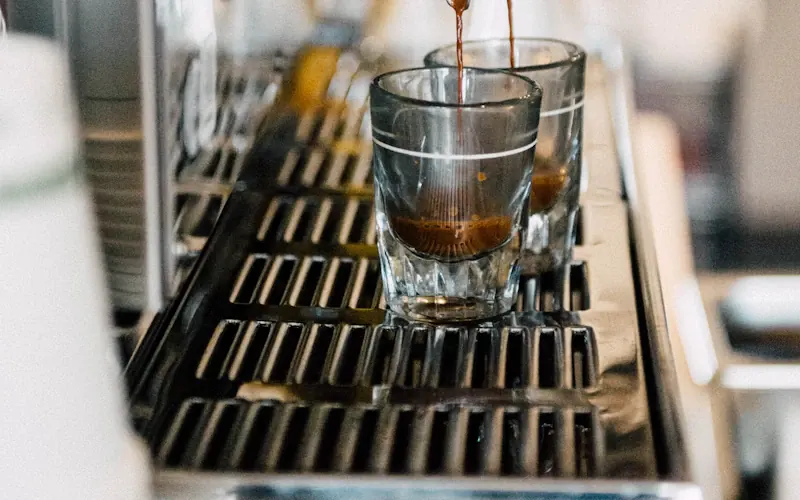
A choking espresso is a machine that pushes water but delivers only a thin trickle or a few drops, sometimes nothing at all. The pump strains, pressure climbs, and the cup stays stubbornly empty. The mechanism is always the same: water can no longer pass through the coffee puck, either because the bed resists too much or because the path itself is blocked. Five causes come up almost every time.
A grind that is too fine is the prime suspect. The finer the grind, the denser the puck and the more it resists water. One step too far on the grinder, and resistance tips from slow into blocked. It is by far the most common cause and the first setting to correct.
A dose too high for the basket comes next. Tamp 21 g into a basket built for 18, and the puck rises too high and compresses against the shower screen the moment the group closes. There is no room left for the coffee to bloom, and the water chokes. Each basket has a usable volume: exceed it and the flow blocks.
An over-firm tamp works the same way. Crushing the puck with excessive force over-compresses it and adds resistance. Exact tamp pressure matters less than people think, but a violent tamp on an already fine grind tips the shot into clogging.
A clogged or dirty basket is the silent cause. Over the weeks, coffee oils and fines block the basket's micro-holes and foul the shower screen. Water no longer finds an even path, even with a flawless recipe. A neglected basket can choke an espresso that poured perfectly the day before.
Finally, an underpowered machine can mimic a block: a small entry-level machine whose pump struggles, or whose pressure exceeds 9 bar because of a poorly set valve, copes badly with a fine grind and tends to choke sooner than a well-calibrated machine.
Choking or just slow flow?
Two situations are often confused. An espresso that just runs slow takes over 35 seconds but pours in a continuous stream: the cup fills, simply too late, a sign of a grind slightly too fine or a slight over-dose. The fix is gentle: half a grind step coarser usually does it.
A choking espresso is a different animal: the flow barely starts, a few drops fall and then nothing, pressure rises with no output, and the puck sometimes comes out waterlogged and stamped with the shower-screen pattern. Here it is no longer about fine-tuning a setting: you need to clearly coarsen the grind, check the dose, lighten the tamp, and inspect the basket. If you are still unsure about reading flow, the guide to espresso running too fast or too slow sets out these thresholds in detail.
How do you clear a clogged puck, step by step?
This routine frees the puck and stabilises the flow. The golden rule still applies: change only one variable at a time, otherwise you will never know what freed the shot.
- Coarsen the grind one step at a time. Grind one step coarser, then purge a few grams to clear old grounds from the grinder. This is the most powerful lever: a less fine puck lets water through again. The grind size by method guide places the espresso setting among the others.
- Match the dose to the basket. Weigh the dose on a scale, for example 18 to 20 g for a double basket, to within 0.1 g. If the puck touches the shower screen, drop a gram. Each basket has an optimal volume to respect.
- Tamp consistently, without overdoing it. Set the tamper flat and press straight with moderate, consistent pressure. No need to crush: levelness and consistency matter more than force, especially on an already fine grind. See the tamper and distribution guide.
- Clean the basket and shower screen. Brush the basket, check the micro-holes are not blocked with oils or fines, and clean the shower screen. On compatible machines, backflush regularly with cleaning detergent and descale according to your water hardness.
- Check pressure and pull again. Confirm the machine delivers around 9 bar at extraction. Pull the shot, time it, and aim for 25 to 30 s at a 1:2 ratio. If the flow stays blocked, coarsen the grind one more step.
If the puck keeps clogging after these five steps, return to the recipe basics in the home espresso guide: dose, ratio and grind form one inseparable trio.
Which choking symptom points to which cause and fix?
| Symptom | Likely cause | Fix |
|---|---|---|
| Nothing pours, a few drops then a block | Grind far too fine | Coarsen the grind several steps, purge the grinder |
| Puck touches the screen, pattern stamped on it | Dose too high for the basket | Reduce the dose, aim for 18 to 20 g for a double |
| Flow blocked despite a correct recipe | Over-firm tamp | Tamp flat, moderate and consistent pressure |
| Block appeared over time on coffee that poured well | Clogged basket or fouled screen | Clean the basket, backflush, descale |
| Pump straining, pressure climbing with no output | Pressure off range or underpowered machine | Check pressure (around 9 bar), coarsen the grind |
| Pours over 35 s but in a continuous stream | Slow flow, not true choking | Coarsen the grind by just half a step |
Frequently asked questions
Why is my espresso not pouring at all?
An espresso that will not pour (choking) most often comes from a grind too fine, an over-dose for the basket, an over-firm tamp, or a clogged basket. Water cannot pass through a puck that is too dense or compressed. Fix it by coarsening the grind one step at a time and matching the dose to the basket (18 to 20 g for a double), aiming for 25 to 30 seconds at around 9 bar.
What is the difference between a choking espresso and one that just runs slow?
A slow espresso takes over 35 seconds but pours in a continuous stream: a grind slightly too fine or a slight over-dose, fixed with half a step coarser. A choking espresso barely flows, pressure rising with no output: you need to coarsen the grind clearly and check the dose, tamp, and basket cleanliness.
What dose and time should I aim for with a double espresso?
For a standard double basket, aim for 18 to 20 g of ground coffee and a 1:2 ratio (for example 18 g in for 36 g out). The reference flow is 25 to 30 seconds including pre-infusion, at around 9 bar. If the puck clogs at these settings, the grind is almost always too fine or the dose too high for the basket volume.
Can a dirty basket block espresso flow?
Yes. Over time, coffee oils and fines clog the basket's micro-holes and foul the shower screen. Water no longer finds an even path and the flow blocks, even with a correct grind and dose. Brush the basket clean, backflush regularly on compatible machines, and descale according to your water hardness.