Espresso Running Too Fast or Too Slow (Channeling): Diagnosis and Fixes
An espresso that runs too fast (under 20 s) comes from a grind that is too coarse, a dose too low, or an uneven tamp. If it runs too slow (over 35 s), the grind is too fine or the dose too high. Channeling is water carving a preferential channel through the puck: fix it with WDT distribution and a perfectly level tamp. The reference target is 25 to 30 s for a 1:2 ratio, at around 9 bar.
- Flow target: 25 to 30 s for a 1:2 ratio (e.g. 18 g in, 36 g out), at around 9 bar
- Under 20 s = too fast (under-extracted, sour); over 35 s = too slow (over-extracted, bitter)
- Channeling shows as multiple jets, a sputtering flow and early blonding
- Change only one variable at a time and always weigh the dose
- The winning duo against channeling: WDT distribution plus a perfectly level tamp
How do you diagnose an espresso running too fast or too slow?
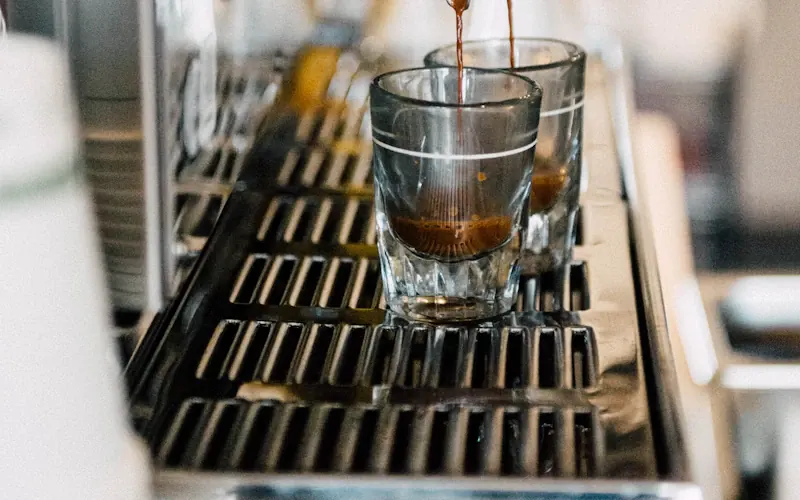
Before you start tweaking everything, put a number on the problem. Espresso flow is simple to measure: the time the drink takes to reach its target weight. For a 1:2 ratio, say 18 g of ground coffee yielding 36 g of espresso in the cup, the reference window is 25 to 30 seconds including pre-infusion, at around 9 bar of pressure. That is the starting point taught by nearly every barista and machine maker, to be refined for each coffee and palate.
Under 20 seconds, the shot runs too fast. Water has not had time to dissolve enough solubles: the cup is under-extracted, sour, thin, with a pale crema that vanishes quickly. Over 35 seconds, the shot runs too slow. Water lingers and pulls out the bitter compounds: the cup turns over-extracted, dry, astringent. Between the two lies the working zone where taste makes the call.
The correction logic fits in one line. Too fast, tighten up: finer grind, slightly higher dose. Too slow, loosen up: coarser grind, slightly lower dose. The most powerful lever is the grind, because it sets the puck's resistance to water flow. For reading taste in more detail, the under and over-extraction guide covers the sensory markers.
What is channeling and how do you spot it?
Sometimes the time looks right on paper, yet the cup stays disappointing and inconsistent shot to shot. The culprit is channeling. Water, which should pass through the puck like an even sponge, finds a less dense zone and races into it: it carves a preferential channel. All the water flows there, and the rest of the bed is barely wetted.
The result is the worst of both worlds. The channel is violently over-extracted, the coffee around it is under-extracted, and the cup mixes bitterness with flat sourness. Worse, flow becomes impossible to repeat: a channel that opens in a different spot each shot explains why a setting that worked yesterday no longer works today.
The signs are clear. With a bottomless portafilter you see multiple or sideways jets instead of a single central stream. On a spouted portafilter the flow sputters, spits in bursts, and the crema blondes too early: that early blonding signals water rushed through one spot. The cause is almost always a badly prepared puck: unbroken grind clumps, a sloped surface, or holes left by careless tamping.
How do you fix espresso flow and channeling, step by step?
This routine addresses both flow rate and channeling. The golden rule: change only one variable per shot, otherwise you will never know what worked.
- Adjust the grind. If the shot runs too fast (under 20 s), grind one step finer. If too slow (over 35 s), grind one step coarser. Purge a few grams after each change to clear old grounds from the grinder. The grind size by method guide places the espresso setting among the others.
- Dose by weight. Weigh every dose on a scale, for example 18 g for a double basket, to within 0.1 g. A floating dose makes flow unreadable: it is the first variable to lock down.
- Distribute with a WDT. Plunge a fine-needle tool into the grounds and stir throughout the depth of the basket to break up clumps. This is the decisive step against channeling: it evens out density before tamping. See the tamper and distribution guide.
- Tamp level. Set the tamper flat and press straight down, without tilting. A sloped puck creates a less dense side where water rushes. Levelness counts more than force: moderate, consistent pressure is enough.
- Check the basket and distribution. Confirm the dose matches the basket volume (neither overfilled nor too shallow), the shower screen is clear, and the surface is clean. Pull the shot, time it, and aim for 25 to 30 s at a 1:2 ratio.
If flow stays unstable after these five steps, return to the recipe basics in the home espresso guide: dose, ratio and grind form one inseparable trio.
Which flow or channeling symptom points to which cause?
| Symptom | Likely cause | Fix |
|---|---|---|
| Runs too fast (under 20 s), sour and thin | Grind too coarse or dose too low | Grind one step finer, match dose to basket |
| Runs too slow (over 35 s) or drips, bitter | Grind too fine or over-dose | Grind one step coarser, slightly reduce dose |
| Multiple or sideways jets (bottomless) | Channeling from clumps or uneven puck | Distribute with WDT, tamp level |
| Sputtering flow, early blonding | Channel opened mid-shot | Improve distribution, tamp straight, check dose |
| Inconsistent shot to shot | Unweighed dose or variable tamp | Weigh to 0.1 g, standardise the routine |
| Time looks right but cup is flat | Pressure off range or unsuitable water | Check pressure (around 9 bar), review water |
Frequently asked questions
What is the ideal espresso shot time?
For a classic 1:2 espresso (for example 18 g of coffee yielding 36 g in the cup), aim for 25 to 30 seconds of flow including pre-infusion, at around 9 bar. Under 20 seconds the shot is too fast and under-extracted. Over 35 seconds it is too slow and risks over-extraction. These are starting points to tune by taste.
What is channeling in espresso?
Channeling is the formation of preferential channels in the puck: water finds the path of least resistance instead of passing evenly through the coffee. The channel is over-extracted, the coffee around it under-extracted. Signs are multiple jets, a sputtering flow and early blonding. The main cause is an unevenly distributed or poorly tamped puck.
Why is my espresso running too fast?
An espresso that runs too fast (under 20 seconds) usually comes from a grind too coarse, a dose too low, or an uneven tamp. Grind one step finer, weigh a dose matched to the basket, tamp flat. If flow stays fast and uneven, it is channeling: use a WDT before tamping.
Why is my espresso running too slow?
An espresso that runs too slow (over 35 seconds) or only drips comes from a grind too fine, an over-dose, or an over-firm tamp. Grind one step coarser, slightly reduce the dose if the basket overfills, and tamp with moderate, consistent pressure. Also check that the basket holes are not clogged.