Best Manual Lever Espresso Machines 2026: Flair, Cafelat Robot, La Pavoni and Spring Lever
- Lever advantages: complete silence, full pressure control, no electricity during extraction, extreme mechanical durability
- Cafelat Robot (~€419 regular, ~€499 barista with gauge): Best New Product 2019 at the Specialty Coffee Expo, non-electrical category, direct lever, 58mm portafilter
- Flair 58 (~€700): 58mm standard portafilter, direct lever, portable design, steel and aluminium
- Spring lever (La Pavoni): ~9 bar automatic spring pressure in declining curve, steam wand included
- Key limitation: no steam wand on direct lever machines (Flair, Cafelat Robot), separate frother needed for milk drinks
What does the arm do that a pump cannot?
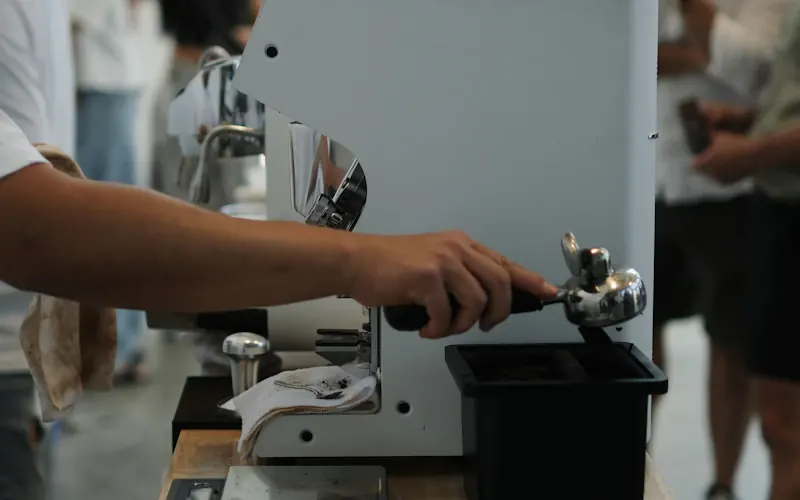
Here's a fact that surprises many coffee enthusiasts: the most advanced espresso extraction technique in competitive coffee, pressure profiling, is something a manual lever machine does naturally by default. Professional baristas at the World Barista Championship spend thousands of euros on sophisticated electronic machines precisely to replicate the variable pressure curves that a direct lever machine produces inherently through simple arm movement.
Lever machines are not relics. They're a deliberate choice: to place the barista physically inside the extraction process, removing the abstraction of an electric pump. The result, when mastered, is espresso with a distinct character, often described as silkier in texture and more complex in flavour than what the same coffee produces on a pump machine. The silence is another revelation: no vibrating pump, no mechanical noise, just the quiet descending hiss of water through coffee.
How far can a hand-pulled shot drift from the classic 9 bar?
Direct lever (Flair 58, Cafelat Robot): pressure is generated entirely by your arm and body weight. You control the pressure curve in real time, start at 3-4 bars for pre-infusion, peak at 9 bars during extraction, taper to 6-7 bars at the finish. This is natural pressure profiling. The disadvantage: requires consistent physical effort and a feel for pressure that develops over weeks of practice.
Spring lever (La Pavoni, Elektra Micro Casa): a compressed spring is loaded when you raise the lever. When released, the spring automatically generates approximately 9 bars of pressure in a naturally declining curve, starting high and ending around 3-4 bars as the spring exhausts. This profile is consistent and reproducible without requiring tactile skill, making spring lever generally easier to master for beginners. The trade-off: less fine-grained control over pressure timing.
Is the Cafelat Robot still the usual first lever machine?
For most people, yes. The Cafelat Robot (~€419 regular, ~€499 barista) remains the standard recommendation for anyone entering manual lever espresso. Designed by Paul Pratt and hand-assembled from polished metal parts, with no plastic and no electronics in the brew path, it was named Best New Product at the 2019 Specialty Coffee Expo in the consumer non-electrical equipment category.
Its 58mm standard portafilter is identical to those used on prosumer pump machines, every accessory on the market (tampers, puck screens, WDT tools, baskets) is compatible. The extraction chamber is heated by immersion in hot water, which is simple but effective at maintaining group temperature for a single shot. No electronics, no pump, no moving parts beyond the lever mechanism. Mechanical durability is exceptional.
The main challenge: the regular version has no integrated pressure gauge. Pressure control is entirely tactile, you learn to feel the resistance and adjust accordingly. This is satisfying but requires practice. The barista version answers that with a factory-fitted gauge, and for a more guided introduction still, the Flair Pro 2 may suit impatient learners better.
The Flair 58 and the Flair Pro 2 fold into a bag, but at what cost to the shot?
Very little, is the short answer. The Flair range, designed in California by Flair Espresso (Intact Equipment), offers a proposition none of its rivals match: fully portable lever espresso. The extraction head and lever assembly disassemble to fit in a travel bag, and nothing in that packing sequence touches the pressure the arm can apply once the machine is reassembled.
The Flair 58 (~€700) is the flagship: 58mm portafilter, stainless steel and anodised aluminium construction, and a separable brew head that can be preheated independently for better thermal stability. Its successor, the Flair 58 Plus 2, adds an integrated electric preheat controller and sells for around €820 through authorised European dealers. The Flair Pro 2 is the predecessor model, slightly less refined but featuring an integrated pressure gauge, a significant learning aid. The Pro 2 also accepts an optional spring lever kit, adding spring lever mode as an alternative to direct control. That PRO line now runs as the Flair PRO 3, with a redesigned brew head, at roughly €300 to 350.
On a La Pavoni Europiccola, which variables move together?
Boiler pressure, group temperature and the timing of the pull, all three at once. The La Pavoni Europiccola (~€650 to 900) is one of the most recognisable objects in Italian design history, first produced in 1961, unchanged in principle for 65 years. Its spring lever generates a ~9 bar declining curve automatically. Critically, it includes a steam boiler: after extraction, you can steam milk for cappuccino or latte, making it the most versatile lever option for milk-drink lovers among the machines reviewed here.
The La Pavoni demands more than most lever machines: boiler pressure management, group temperature, and shot timing are interdependent variables that synchronise only through experience. It rewards persistence with an espresso that many enthusiasts consider among the most characterful they have ever tasted. The mechanical quality is such that La Pavoni machines routinely pass between generations within the same family.
Other notable spring lever machines: the Elektra Micro Casa a Leva (chrome-plated brass, made in Italy, exceptional aesthetics, premium pricing) and the Londinium R24 (commercial-grade spring lever for high-volume home use).
Comparison table 2026
| Machine | Lever type | Portafilter | Steam wand | Price | Buy |
|---|---|---|---|---|---|
| Cafelat Robot | Direct | 58mm | No | ~€419 to 499 | Amazon UK |
| Flair Pro 2 | Direct (spring opt.) | 58mm | No | ~€300 to 350 | Amazon UK |
| Flair 58 | Direct | 58mm | No | ~€700 | Amazon UK |
| La Pavoni Europiccola | Spring (~9 bar) | 49mm | Yes | ~€650 to 900 | Amazon UK |
* Affiliate links, commission on qualifying purchases, no extra cost to you.
Who should choose a lever machine?
Lever is ideal if: you value espresso as a craft practice and want to understand every variable; silence matters (apartment mornings); you're willing to invest 2-4 weeks in developing tactile feel; you want compactness or portability (Flair, Cafelat Robot); you primarily drink black espresso.
Lever is not ideal if: you primarily drink milk-based drinks (no steam on direct lever models); you need multiple quick shots in succession; you want a machine that works reliably without attention every morning.
Recommended accessories
Frequently asked questions
What is the difference between a direct lever and a spring lever espresso machine?
A direct lever (Flair 58, Cafelat Robot) generates pressure through your arm and body weight, you control the pressure curve in real time (natural pressure profiling). A spring lever (La Pavoni, Elektra) uses a compressed spring that automatically generates ~9 bars in a declining curve when released. The spring is more reproducible; the direct lever offers more control but requires more experience.
Why choose a lever machine over a pump espresso machine?
Lever machines offer: complete silence during extraction, full pressure control (natural pressure profiling on direct lever models), zero electricity consumption during extraction, extreme mechanical durability, and often compact and portable design. The main limitation: no steam wand on direct lever models (Flair 58, Cafelat Robot), a separate milk frother is needed for milk-based drinks.
Is the Cafelat Robot a good lever machine for beginners?
Yes, the Cafelat Robot (~€419 in the regular version) is one of the best entry points into lever espresso, and it was named Best New Product at the 2019 Specialty Coffee Expo in the non-electrical category. Its 58mm standard portafilter accepts all market accessories. The main challenge for beginners: the regular version has no pressure gauge, so pressure control is entirely tactile. The barista version (~€499) and the Flair Pro 2 both ship with a gauge and offer a more guided alternative.
Can lever espresso machines steam milk?
Direct lever machines (Flair 58, Flair Pro 2, Cafelat Robot) have no integrated steam boiler, a separate milk frother is needed. Spring lever machines like the La Pavoni Europiccola include a steam boiler and can texture milk after extraction, though steam quality is lower than prosumer dual-boiler machines.
Ready to explore manual lever espresso?
View lever espresso machines on Amazon UK →Further reading: Best espresso machines 2026 · Single-dose grinding guide · Ristretto vs espresso vs lungo
Affiliate links: as an Amazon Associate, expertcafe.be earns from qualifying purchases at no extra cost to you.