Best Espresso Machines With Built-In Grinder 2026: The All-in-One Round-Up
- An all-in-one is a deliberate compromise: one appliance and less counter space, but a grinder that has to be simplified to fit
- Semi-automatic to learn and grow: De'Longhi La Specialista Arte Evo (around 449 EUR) or Sage Barista Pro (around 599 EUR)
- Assisted tamping and comfort: Sage Barista Express Impress (around 679 EUR)
- Bean-to-cup, one touch and it is served: Philips Series 3200 LatteGo (around 599 EUR) or Gaggia Cadorna Prestige (around 649 EUR)
- Top-tier semi-automatic: De'Longhi La Specialista Maestro or Sage Barista Touch Impress (around 1299 EUR)
- For the same money, a dedicated grinder plus a separate machine usually pours a better cup. The combo wins on practicality, not on the very peak of quality
Our 2026 selection: espresso machines with a built-in grinder
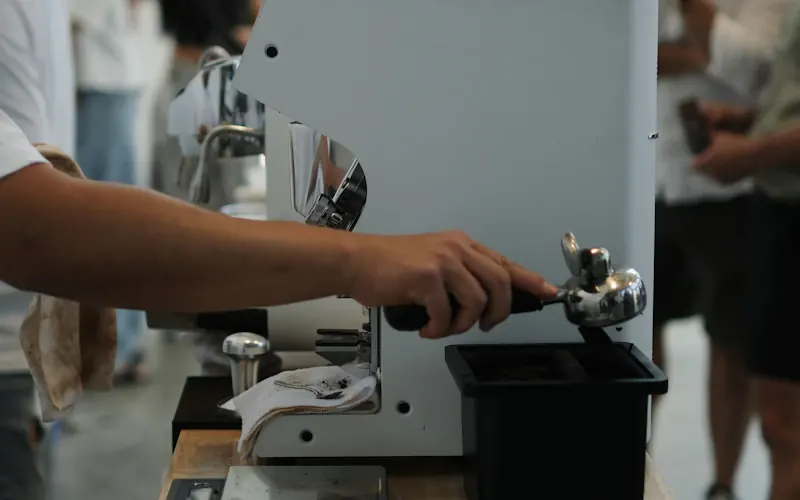
Start with a distinction most pages blur, and which decides everything at the till. An espresso machine with a built-in grinder is not the same animal as a bean-to-cup automatic. The first is a semi-automatic: it grinds and doses, then you tamp, pull the shot and steam the milk. The second does the lot at one touch, grinding included, with no portafilter in sight. Both carry a grinder inside the housing, but they court very different drinkers. Here is our 2026 selection, with EUR prices checked in early September at European price comparison sites (idealo, Geizhals) and offered as a snapshot, since they move with stock and promotions. Euros, not a currency-converted guess, because this is written for a European and Belgian audience.
| Model | Type | Grinder | Indicative price (EUR) | Best for | Buy |
|---|---|---|---|---|---|
| De'Longhi La Specialista Arte Evo | Semi-automatic, built-in grinder | Conical, 8 settings | ~449 EUR | Learning with hands on the shot | Check price on Amazon |
| Sage Barista Pro | Semi-automatic, built-in grinder | Baratza conical, 30 settings | ~599 EUR | The all-in-one reference, daily espresso | Check price on Amazon |
| Philips Series 3200 LatteGo | Bean-to-cup automatic | Ceramic, 12 levels | ~599 EUR | One touch, zero effort, auto milk | Check price on Amazon |
| Gaggia Cadorna Prestige | Bean-to-cup automatic | Ceramic, user profiles | ~649 EUR | Italian bean-to-cup, saved profiles | Check price on Amazon |
| Sage Barista Express Impress | Semi-automatic, built-in grinder | Conical, assisted tamping | ~679 EUR | Consistent dosing and tamping | Check price on Amazon |
| De'Longhi La Specialista Maestro | Semi-automatic, built-in grinder | Conical, Sensor Grinding | ~1299 EUR | Demanding enthusiast, LatteCrema, deep manual control | Check price on Amazon |
* These links may earn a commission if you make a purchase, at no extra cost to you. Indicative prices checked in September 2026, varying by retailer and colour. Learn more.
Analysis by budget: which all-in-one for which investment?
Under 600 EUR: the smart entry into espresso with a grinder
Two philosophies share this bracket. On the semi-automatic side, the De'Longhi La Specialista Arte Evo (around 449 EUR) is the most complete entry point: a built-in conical grinder with eight settings, a doser and three temperature levels. It leaves the tamping and the shot to you, which makes it a genuine learning machine at a contained price. The Sage Barista Pro (around 599 EUR) is, to my taste, the all-in-one reference here: a near-instant ThermoJet heating system, a thirty-setting Baratza conical grinder and an LCD that walks you through the dose. It is the machine I recommend most often to anyone wanting to improve without overspending. On the bean-to-cup side, the Philips Series 3200 LatteGo (around 599 EUR) aims at the opposite drinker: coffee at one touch, milk foam included via the easy-clean LatteGo system, a twelve-level ceramic grinder and not a portafilter to manage.
What to avoid in this range: machines sold as bean-to-cup but fitted with a token grinder that barely adjusts. Without grind control the espresso stays flat. A well-dialled Arte Evo beats a low-cost automatic with a frozen grind every time.
600 to 800 EUR: comfort and a polished bean-to-cup
The Gaggia Cadorna Prestige (around 649 EUR) is a fully featured Italian bean-to-cup: a colour TFT screen, a broad drinks menu, saved user profiles and a ceramic grinder. It suits the household that wants bean-to-cup convenience with a little personalisation. On the semi-automatic side, the Sage Barista Express Impress (around 679 EUR) adds the Impress assisted tamping: a lever that applies a consistent, repeatable pressure, removing one of the biggest sources of inconsistency for a beginner. For anyone who wants the barista's control without botching the tamp every other morning, that is a real gain.
Beyond 1200 EUR: the demanding enthusiast tier
At this level two semi-automatics stand out around 1299 EUR. The De'Longhi La Specialista Maestro (around 1299 EUR) carries Sensor Grinding, which calibrates the ground dose to the chosen fineness, plus the LatteCrema system for quality automatic milk foam, while keeping deep manual control. The Sage Barista Touch Impress (around 1299 EUR) pairs the Impress assisted tamping with a touchscreen that stores complete recipes, grind and milk included. The choice is philosophical: the Maestro leans toward guided manual craft, the Touch Impress toward a recipe recalled at a tap.
Where does a shared body help the shot, and where does it hold it back?
Let me say the part that round-ups tend to dodge. For the same budget, a dedicated grinder plus a separate machine pours a better cup than a combo in most cases. The reason is mechanical: to house a mill in the same body as the boiler and the pump, the maker shrinks the burrs, simplifies the adjustment range and limits heat dissipation. A 300 EUR grinder sitting next to an entry-level machine produces a more even particle distribution, and therefore a cleaner extraction, than a built-in grinder of the same total cost folded into one appliance.
So why buy an all-in-one at all? For three concrete and entirely fair reasons. First, footprint: one appliance on the counter instead of two, which matters enormously in a small kitchen. Second, entry cost: at the lower end a combo costs less than a machine plus a grinder of comparable quality. Third, simplicity: one plug, one cleaning routine, one grind-to-portafilter path with nothing to decant.
Two consequences of the shared body only surface later. Grind changes travel slowly, because the adjustment sits on the same chassis as the group and a new setting needs a dose or two before the cup reflects it. Repairs travel badly as well: the appliance leaves for service with the mill inside, so the kitchen loses both functions at once.
The honest verdict fits in a sentence. If you chase the absolute peak of quality and counter space is no object, go for a separate machine and a dedicated grinder. If you want excellent everyday espresso without crowding the kitchen or juggling two appliances, a good all-in-one like the Sage Barista Pro will take you a very long way, far past where most drinkers ever arrive.
Which checks matter most when one appliance grinds and brews?
Five things tell you how well the mill and the group have been matched inside one body.
Semi-automatic or bean-to-cup: this is the first call. The semi-automatic (portafilter) asks for technique and rewards practice with a far better cup. The bean-to-cup automatic does everything at one touch, ideal for convenience and volume, but caps lower on espresso finesse.
Grinder quality: favour conical burrs with a genuine adjustment range, at least thirty settings on the Sage side. A frozen grinder or one with too few steps permanently throttles the extraction.
Heating system: a ThermoJet or equivalent reaches temperature in seconds, which transforms the morning routine and the thermal stability from cup to cup.
Milk system: a manual steam wand (Sage Barista Pro, one to master) for latte art, or an automatic frother such as LatteGo and LatteCrema (Philips, De'Longhi Maestro) for simplicity.
Maintenance: a combo concentrates mill and brew group, so regular burr cleaning and descaling decide its lifespan. Favour brands with service and parts available in Europe.
Mistakes to avoid when buying
- Confusing semi-automatic and bean-to-cup: they are not the same gestures or the same result. Know which morning you want before you pay.
- Buying a bean-to-cup for latte art: most foam the milk automatically, with no steerable wand. Latte art needs a manual steam wand.
- Reaching for the top tier before you know your taste: a 1299 EUR machine only makes sense if you genuinely enjoy the barista ritual. Start lower and climb later.
- Neglecting the grinder, assuming the machine compensates: no boiler fixes an uneven grind. The built-in grinder remains the heart of the cup.
- Forgetting the running cost: filtered water, descaler, burr cleaning. A poorly maintained combo degrades fast, mill and brew group at once.
Frequently asked questions about espresso machines with a grinder
What is the best espresso machine with a built-in grinder in 2026?
It depends on budget and type. Among semi-automatics: De'Longhi La Specialista Arte Evo (~449 EUR) to start, Sage Barista Pro (~599 EUR) as the all-in-one reference, Sage Barista Express Impress (~679 EUR) for assisted tamping, De'Longhi La Specialista Maestro or Sage Barista Touch Impress (~1299 EUR) at the top. Among bean-to-cup automatics: Philips Series 3200 LatteGo (~599 EUR) and Gaggia Cadorna Prestige (~649 EUR). For the same money a separate grinder plus a machine usually pours a better cup, but the combo wins on simplicity and counter space.
What is the difference between a semi-automatic with grinder and a bean-to-cup machine?
A semi-automatic with a built-in grinder (Sage Barista Pro, De'Longhi La Specialista) grinds and doses, but you tamp, pull the shot and steam the milk: it teaches the barista's craft and has a very high ceiling. A bean-to-cup automatic (Philips 3200 LatteGo, Gaggia Cadorna Prestige) does everything at one touch, with no portafilter, favouring convenience over control. Semi-automatic to learn, bean-to-cup for daily simplicity.
Is an all-in-one built-in grinder as good as a separate grinder plus machine?
For the same budget, usually not. A built-in grinder is a packaging and cost compromise, with smaller burrs and a narrower adjustment range than a 300 EUR standalone. A separate setup often grinds more evenly, and so extracts more cleanly. The all-in-one wins back on three points: less counter space, lower entry cost, simpler to live with. The choice is between peak cup quality and everyday practicality.
Which espresso machine with grinder should a beginner buy?
To start with hands on the shot, the De'Longhi La Specialista Arte Evo (~449 EUR) or the Sage Barista Pro (~599 EUR) are the best semi-automatic entry points: a built-in grinder and real room to grow. For zero effort, the Philips Series 3200 LatteGo (~599 EUR) bean-to-cup is the better call. Avoid stretching to 1299 EUR before you know you enjoy the barista ritual, or dropping to a machine with no proper adjustable grinder.
Ready to choose your built-in grinder machine?
See the best machines on Amazon →Further reading: Best espresso machines 2026 · Best coffee grinders 2026 · Specialty coffee FAQ
Affiliate links: as an Amazon Associate, expertcafe.be earns from qualifying purchases at no extra cost to you. Learn more.