Best Coffee Grinders 2026: Ranked by Budget and Use
- The grinder shapes the cup more than the machine does, so it should take priority in any budget
- Under 200 EUR: Baratza Encore ESP (versatile electric, around 149 EUR) or 1Zpresso JX-Pro (premium manual, around 159 EUR)
- 200 to 300 EUR: Comandante C40 MK4 (around 219 EUR), the travel and premium filter reference
- 400 EUR and up: Eureka Mignon Specialita (flat burrs, espresso, around 429 EUR), DF64 Gen 2 (flat single dose, around 399 EUR) or Niche Zero (conical, versatile, around 599 EUR)
- Never buy a blade grinder, whatever the budget
Our 2026 selection: top grinders
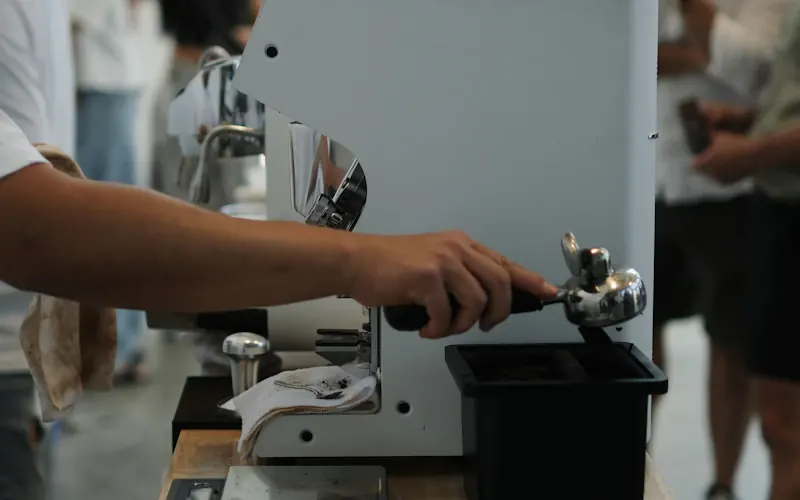
The decisive moment in a cup of coffee lasts a fraction of a second. A roasted bean meets the burrs, breaks apart, and the spread of fragment sizes that falls out of the chute decides almost everything you will taste afterwards. I once watched a barista in Antwerp pour two espressos from the same beans, the same machine, the same dose, the same time, and they tasted like different coffees entirely. The only variable was the grinder. That is the quiet truth this whole category turns on: you are not buying a kitchen gadget, you are buying the gatekeeper of flavour.
After working through grind-quality tests, extraction trials and the kind of long-term reliability that only shows up after a few hundred shots, here is our selection of the best coffee grinders in 2026. Every model below uses burrs, conical or flat, which is the one condition we treat as non-negotiable. Prices are indicative and verified at European retailers in euros (an EU and Belgian audience deserves EUR, not a currency-converted guess), and they shift with stock and promotions, so treat them as a current snapshot rather than a fixed tag.
| Grinder | Type | Burrs | Indicative price (EUR) | Best for | Buy |
|---|---|---|---|---|---|
| Baratza Encore ESP | Electric | Conical 40 mm | ~149 EUR | Beginner to enthusiast, filter and espresso | Check price on Amazon |
| 1Zpresso JX-Pro | Manual | Conical 48 mm, stainless steel | ~159 EUR | Beginner to enthusiast, filter and travel | Check price on Amazon |
| Comandante C40 MK4 | Manual | Conical Nitro Blade | ~219 EUR | Enthusiast, travel, premium filter | Check price on Amazon |
| DF64 Gen 2 | Electric | Flat 64 mm | ~399 EUR | Single dose, espresso and filter, upgradeable burrs | Check price on Amazon |
| Eureka Mignon Specialita | Electric | Flat 55 mm | ~429 EUR | Semi-pro espresso, intensive daily use | Check price on Amazon |
| Niche Zero | Electric | Conical 63 mm | ~599 EUR | Serious home barista, single dose, espresso and filter | Check price on Amazon |
* These links may earn a commission if you make a purchase, at no extra cost to you. Learn more.
Analysis by budget: which grinder for which investment?
Under 200 EUR: the smart entry into burrs
This bracket sets two characters against each other: the versatile electric and the high-quality manual. The Baratza Encore ESP (around 149 EUR at European retailers) is the electric reference. It runs 40 mm conical burrs, splits its adjustment into micro-steps for espresso and macro-steps for filter, and ships with a 54 mm dosing cup plus a 58 mm adapter ring that drops grounds straight into a portafilter. What makes it quietly remarkable is repairability: Baratza sells every part and films the repairs, so this is a grinder you mend rather than replace. The 1Zpresso JX-Pro (around 159 EUR) is the manual answer, with 48 mm stainless steel conical burrs and an adjustment of 12.5 microns per click. Its filter grind shames many electric grinders at twice the price. The cost is in your forearm: budget around forty turns for a fifteen gram dose, which is meditative on a slow Sunday and tiresome before a Monday commute.
What to refuse outright in this range: any blade grinder. A 30 to 50 EUR machine chops beans into ragged fragments by impact. The result is unpredictable and the cup is uneven, and no recipe tweak rescues a grind made by a propeller.
200 to 300 EUR: the peak of manual grinding
The Comandante C40 MK4 (around 219 EUR at European retailers) sits in a class of its own. Built in Germany, its Nitro Blade burrs are forged from a high-nitrogen, high-alloy stainless steel that holds an edge through years of use, and they deliver a particle distribution tuned specifically for fresh specialty arabica. The stainless steel body is built to be dropped in a bag rather than babied, the click adjustment locks settings repeatably, and each unit arrives with two jars, one dark glass and one unbreakable polymer for travel. Its natural home is pour-over, the V60, Chemex and Kalita, where grind consistency translates directly into clarity in the cup. It will pull espresso too, though dialling in fine settings by hand asks more patience than an electric grinder demands.
400 EUR and up: the serious home barista tier
Cross 400 EUR and three philosophies appear. The Eureka Mignon Specialita (around 429 EUR) runs 55 mm flat burrs and is built for espresso first: a bright, defined cup, a famously quiet operation and the kind of stepless dial that makes micro-adjustments feel effortless during intensive daily use. The DF64 Gen 2 (around 399 EUR) brings 64 mm flat burrs into single-dose territory: a built-in ionizer tames static, an anti-popcorn disc steadies the feed, retention sits under a tenth of a gram, and crucially the 64 mm platform accepts aftermarket SSP burrs for those who like to tinker. The Niche Zero (around 599 EUR, sold across Europe direct from the manufacturer) takes the conical route: 63 mm burrs, an infinite dial and a straight-through path that leaves almost nothing behind, which makes it the dream of anyone who switches origins constantly. Its cup is round and forgiving. The decision among the three comes down to character and workflow: daily espresso and clarity point to the Eureka or DF64, while versatility and frequent single dosing point to the Niche.
How do two burr shapes end up making two different particle curves?
Flat burrs are two parallel horizontal discs that shear the beans between their faces. They produce a bimodal particle distribution, two clustered size peaks, which favours a clean extraction with bright aromatics and a well-defined acidity. They generate more friction heat and tend to hold more coffee between the discs, which is why they suit grinders built for continuous or high-volume use, and why static and retention management matter so much on flat-burr machines like the DF64 Gen 2.
Conical burrs work with a cone spinning inside a fixed ring. They run cooler, run quieter, retain very little coffee and give a rounder, fuller cup with softer aromatic edges. They are the more versatile shape: they handle espresso, filter, AeroPress and French press with equal ease. The Niche Zero, the Comandante and the Baratza all sit in this camp, which is part of why they forgive a wider range of brew methods.
The practical summary: if you make mostly espresso on a capable machine and chase maximum precision, lean toward flat burrs (Eureka Mignon Specialita, DF64 Gen 2, or professional tiers like the Mahlkönig E65S). If you change brew method or origin often, conical burrs offer more versatility with a gentler learning curve.
What tells you, before buying, how evenly a grinder will cut?
Burr size: wider burrs mean higher throughput and less heat per gram. Past roughly 50 mm (flat) or 55 mm (conical), you are entering professional territory, which is where the Niche Zero (63 mm) and DF64 Gen 2 (64 mm) earn their cup quality.
Adjustment range: an espresso grinder needs very fine control, micro-adjustments of a few microns at a time. A filter grinder can live with broader steps. The best offer either stepless (infinite) adjustment or very fine steps, thirty or more clicks per rotation.
Retention: the amount of coffee left in the grind path after each dose. High retention (five grams or more) is a real problem for single dosing and for anyone changing origins often, which is exactly the deficiency the Niche Zero and DF64 Gen 2 are engineered to eliminate.
Noise: flat-burr grinders are generally louder (65 to 75 dB) than conical ones (50 to 65 dB). The Niche Zero measures around 72 dB during grinding, so for early apartment mornings a quieter conical or the deliberately hushed Eureka is the kinder housemate.
Burr alignment and wear: two burrs held perfectly parallel cut the whole charge into the same size band. A small misalignment widens the spread and lifts the share of fines, which shows up in the cup as a muddier, less separated extraction. Wear does the same thing over years rather than seconds, and the tell is simple: when you have to grind finer than usual to reach your normal flow time, the burrs are near the end of their life.
Repairability: a repairable grinder is always worth more than a sealed one at the same price. Baratza is exemplary here, with every part available and the repairs documented on video.
Mistakes to avoid when buying
- Buying a blade grinder: whatever the brand or price. Blades chop, they do not grind, and the particle distribution is impossible to control.
- Underspending on the grinder: an 800 EUR espresso machine fed by a 50 EUR grinder is wasted money. Reinvesting in a Baratza Encore ESP transforms the very same machine.
- Buying a filter-only grinder for espresso: fine espresso settings (particles around 200 to 400 microns) demand a grind range that pure filter grinders do not cover properly.
- Ignoring the brand for servicing: favour brands that sell spare parts and support customers in Europe, so a worn burr does not retire the whole grinder.
- Confusing speed with quality: a slower grinder (300 to 450 rpm) extracts aromatics with less friction heat. Raw speed is not a quality signal in itself.
Frequently asked questions about coffee grinders
What is the best coffee grinder in 2026?
There is no single best grinder, only the best for your budget and method. Under 200 EUR, the Baratza Encore ESP (around 149 EUR) is the most versatile electric pick and the 1Zpresso JX-Pro (around 159 EUR) the standout manual. Around 219 EUR, the Comandante C40 MK4 leads for filter. From 400 EUR up, the Eureka Mignon Specialita (around 429 EUR) excels at espresso, the DF64 Gen 2 (around 399 EUR) at flat-burr single dosing, and the Niche Zero (around 599 EUR) at low-retention versatility. The one rule that always holds: choose burrs over blades, even at entry level.
Are flat or conical burrs better for espresso?
For espresso, flat burrs (Eureka Mignon Specialita, DF64 Gen 2) tend to give a clean, defined cup with bright, well-separated flavours, thanks to a more uniform particle distribution. Conical burrs (Niche Zero, Baratza, Comandante) deliver a rounder, softer, more forgiving profile with less heat. Flat burrs reward precision and clarity; conical burrs reward versatility and ease. Both work beautifully for espresso once you cross the 300 EUR mark, so it comes down to the cup character you prefer.
Why does the grinder matter more than the coffee machine?
The grinder sets the extraction surface and the consistency of the particles, which the machine can only work with, never fix. An uneven grind, as a blade grinder produces, creates over-extracted (bitter) and under-extracted (sour) particles in the same shot at once, and no machine corrects that. This is why baristas invest more in the grinder than the machine: for a 1000 EUR setup, a 60-40 split favouring the grinder beats an 80-20 split favouring the machine.
Which coffee grinder should a beginner buy for under 200 EUR?
Under 200 EUR, the Baratza Encore ESP (around 149 EUR) is the most versatile pick: 40 mm conical burrs, micro-steps for espresso and macro-steps for filter, and full repairability since every part is sold separately. As an alternative, the 1Zpresso JX-Pro (around 159 EUR) is manual but grinds better than many electric rivals in the same bracket. Avoid any blade grinder completely, even at 50 EUR, because it chops rather than grinds and makes extraction impossible to control.
Ready to choose your grinder?
See the best grinders on Amazon →Further reading: Coffee grinder guide: flat vs conical, settings and diagnosis · Single-dose grinding and retention · Grind size by brew method · Best manual coffee grinders 2026
Affiliate links: as an Amazon Associate, expertcafe.be earns from qualifying purchases at no extra cost to you. Learn more.