☕ Key takeaways
- The grinder is the most decisive link in the brewing chain: uneven grind guarantees inconsistent extraction regardless of coffee price or machine quality.
- Flat burrs produce a tight, uniform particle distribution (ideal for precise espresso and filter); conical burrs generate more fines but deliver more body and less heat transfer.
- Indicative European street prices, September 2026: nothing but blade grinders below €60; €70 to €200 buys a conical hand grinder or a first electric; €230 to €500 buys a 54 to 64 mm flat-burr electric; past €600 you are paying for larger burrs and near-zero retention.
Coffee Grinder Guide: Flat vs Conical Burrs, Budgets, Brands
3 key takeaways
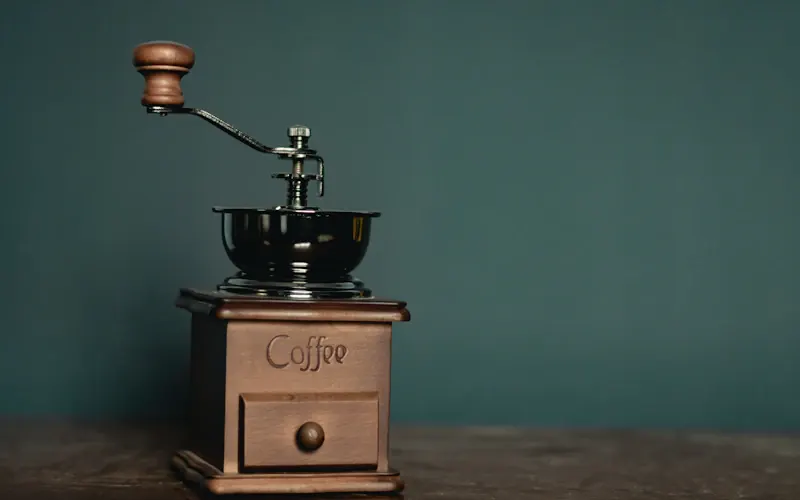
- A burr grinder fixes particle size with a mechanical gap the user sets; a blade grinder fixes nothing and simply chops for as long as the button is held. That is a difference of principle, not of price.
- Three parts govern grind quality: burr geometry, how true the two burrs stay under load, and the rigidity of the shaft carrying them. Housing, display and hopper have no bearing on particle size.
- A hand grinder needs 45 to 60 seconds of cranking for a 15 to 20 g filter dose, and three to four minutes for the 60 g a litre takes. Throughput, not grind quality, is what pushes people towards an electric.
A first burr grinder: Baratza Encore ESP, 40 mm steel conical burrs, roughly €180 to €220 in September 2026, with spare parts sold individually
Same grind quality without a motor: Comandante C40 MK4, manual, conical Nitro Blade burrs in high-nitrogen stainless steel, roughly €280 to €320
Strip a coffee grinder down and very little is left: two abrasive surfaces, an adjustable gap between them, a shaft to drive them. Everything else on the machine is packaging around those three parts. This guide takes the grinder as a piece of hardware, looking at how the burrs are mounted, what alignment changes, why speed and retention matter, and what a step up the price ladder actually buys.
Where does grind consistency actually come from?
Ready to choose? → See our comparison and current prices
From a gap, not from a motor. A burr grinder holds two abrasive surfaces a set distance apart, and a bean only leaves the chamber once it has been reduced below that distance. The dimension is imposed by the machine and repeated identically on every bean, which is what makes the output predictable.
A blade grinder imposes no dimension. An impeller spins at the bottom of a cylinder and strikes whatever it meets, for as long as the button is held down. What comes out is a mix of dust-fine particles that over-extract into bitterness and coarse chunks that under-extract into sourness, and running the machine longer only shifts the proportions.
A burr grinder uses two abrasive surfaces held at a precise, adjustable distance apart. Coffee is sheared between them into particles of a consistent, controlled size. The result is even extraction, and a cup that actually tastes like the coffee you paid for.
What does a flat burr set look like inside the machine?
Picture two toothed discs stacked face to face, the lower one fixed and the upper one driven. Beans drop through a hole in the middle, get caught between the teeth and are thrown outward to the rim, falling into a catch container once they are small enough to escape. Because the disc itself does the transporting, the set runs at higher RPM and generates slightly more heat, but it produces an exceptionally narrow particle size distribution, meaning most particles are very close to the same size.
What this sounds like in the cup: flat burrs tend to produce a cleaner, brighter, more analytically precise flavour. Acidity is well-defined and structured. Sweetness is clear. They are the preferred choice for filter coffee and espresso when clarity and precision are the goal. Machines built around flat sets include the Eureka Mignon series, the Mahlkönig X54, the Fellow Ode Gen 2 with its 64 mm burrs, and the 54 mm DF54.
How does a conical set move coffee through the grinder?
Downward, and mostly under its own weight. The inner cone turns inside a fixed outer ring on a vertical axis, so gravity does the feeding while the teeth shear the bean in a descending spiral. Handing the transport job to gravity means the set can turn more slowly, which means less heat and less noise. It also keeps retention very low, since little coffee stays stuck in the grinding chamber, and it gives a slightly wider particle distribution with fewer extreme fines.
In the cup: conical burrs tend to produce a rounder, sweeter, softer result. Body is more pronounced, and the flavour profile feels more integrated and less analytical. They are especially well-suited to pour-over methods (V60, Chemex), French press, and AeroPress. Machines built around conical sets include the Baratza Encore and Encore ESP, the Virtuoso+, the hand grinders from Comandante and 1Zpresso, and the 63 mm Niche Zero.
Which part of the grinder does your routine put under strain?
Espresso is hardest on the adjustment mechanism: it has to travel a few microns and land back on the same setting tomorrow morning. Small pour-over doses are hardest on retention, since you swap coffees often and the last dose is still sitting in the chute. Large filter batches are hardest on the motor and the exit path, which have to clear 60 g in one run without warming the grounds. The table below pairs each routine with the part it tests most.
| Brewing method | Recommended burr type | Key priority |
|---|---|---|
| Espresso | Flat or conical (espresso-spec) | Precise stepless adjustment |
| Pour-over (V60, Chemex) | Conical preferred | Low retention, clean filter grind |
| Batch drip | Either | Consistency, medium grind range |
| French press | Conical preferred | Coarse grind, few fines |
| AeroPress | Either | Versatility across grind range |
| Moka pot | Flat preferred | Consistent fine grind |
What are you actually paying for as the price climbs?
Ask what the extra money touches and the housing never comes up. It goes into burr diameter first, which moves from 40 mm to 54 or 64 mm and clears the dose faster and cooler. Then into the burr carrier, machined rather than moulded, so alignment holds when beans force their way through. Then into the adjustment, whose thread gets finer and loses its backlash, so coming back to a setting comes back to the same gap. Prices below are indicative European ranges checked in September 2026.
| Model | Burrs | Diameter | Price | Best use | Strength | Limitation |
|---|---|---|---|---|---|---|
| Baratza Encore ESP | Conical steel | 40 mm | €180 to €220 | Filter + light espresso | Every spare part sold separately | Noisy, plastic body |
| DF54 | Flat steel | 54 mm | €230 to €280 | Espresso + filter, single dose | Stepless, very low retention | Uneven finish |
| Fellow Ode Gen 2 | Flat steel | 64 mm | €330 to €400 | Filter only | Low retention, small footprint | Does not reach espresso fineness |
| Eureka Mignon Specialita | Flat steel | 55 mm | €420 to €480 | Espresso | Quiet, stepless micrometric adjustment | Noticeable retention |
| Baratza Vario+ | Flat ceramic (Ditting) | 54 mm | €480 to €550 | Espresso + filter | 230 positions, timed dosing | Stepped, not stepless |
| Niche Zero | Conical steel | 63 mm | €600 to €700 | Espresso + filter, single dose | Retention close to zero | No timed dosing |
| Mahlkönig X54 | Flat steel | 54 mm | €650 to €800 | Espresso + filter | Stepless, 1,050 rpm motor | Price |
Where does the money go in a hand grinder?
Almost entirely into the parts that set the grind, because there is no motor, no gearbox and no electronics to fund. A Timemore C3 (38 mm conical, €70 to €90), a 1Zpresso JX-Pro (48 mm, €140 to €170) or a Comandante C40 MK4 (€280 to €320) therefore carry a burr set and a bearing arrangement that an electric only matches from around €300 to €500. What you pay instead is time at the crank: roughly 45 to 60 seconds for a 20 g pour-over dose, three to four minutes for the 60 g a litre of batch brew takes.
Which numbers on a grinder spec sheet actually matter?
- Burr diameter: a larger set clears the dose faster and heats it less. Home machines sit between 38 and 64 mm; counter machines run 64, 65 or 75 mm.
- Burr alignment: the figure no spec sheet publishes. Check it on arrival by closing the adjustment slowly until the burrs touch, and listening for whether contact starts all the way round or on one side only.
- Retention: the amount of coffee left in the grinding chamber between uses. Low retention is critical for single-dosing and for switching between coffees.
- Adjustment type: stepped (fixed positions) or stepless (infinite micro-adjustment). Stepless is essential for precise espresso dialling.
- Rotation speed: a lower speed means less heat and less noise. Home grinders usually run between 400 and 1,400 rpm: the Baratza Encore ESP turns at 550 rpm, the Mahlkönig X54 at 1,050 rpm and the DF54 at 1,400 rpm.
What makes people outgrow a grinder within a year?
- Buying a blade grinder: the false economy that costs you every morning. Avoid entirely.
- Buying a filter grinder for espresso: filter grinders cannot reach the precise fine end of the grind range that espresso requires.
- Skipping maintenance: coffee oils coat the burrs over time, turning rancid and affecting flavour. Clean monthly with grinder cleaning tablets (such as Grindz).
- Judging a grinder by its hopper capacity: hopper size is irrelevant for single-dosing and often just a marketing number.
The grinder is where your coffee journey either accelerates or stalls. Every other variable, water, machine, technique, expresses its full potential only when the grind is consistent and precise.
Our picks
Two machines answer two different mechanical questions. The Comandante C40 MK4 puts the whole budget into the burr set and the bearings: conical Nitro Blade burrs whose ring and core are both cut from a solid block of high-alloy, high-nitrogen stainless steel, with no motor to pay for. The Baratza Encore ESP answers the opposite question, which is what happens after two years of daily use: 40 mm steel conical burrs in a machine whose spare parts are sold individually, so a worn burr set or a failed gearbox is a repair rather than a replacement. Neither is an upgrade over a blade grinder in degree; they belong to a different mechanical family.
View coffee grinders on Amazon →Which three models make our shortlist?
* These links may generate a commission if you make a purchase, at no extra cost to you. Learn more.
Affiliate links: as an Amazon Associate, expertcafe.be earns from qualifying purchases at no extra cost to you. Learn more.
Frequently asked questions
Where does grind consistency actually come from?
It comes from a mechanical gap. In a burr grinder, two abrasive surfaces are held a set distance apart and a bean only leaves the chamber once it has been reduced below that distance. A blade grinder sets no dimension at all: an impeller spins at several thousand revolutions per minute and hits whatever it meets, for as long as the button is held down. That is the whole difference between the two families, and no amount of running time turns one into the other.
Stepped or stepless adjustment: which one do you need?
Stepped adjustment locks into fixed positions, so a setting can be found again exactly, but the jump between two neighbouring steps can be too coarse for espresso. Stepless adjustment allows a correction of a few microns, which is what dialling a shot to a target flow time requires. Filter brewing rarely needs more than a stepped mechanism. Watch the wording on spec sheets: the Baratza Vario+ advertises 230 positions, but those are steps, not stepless adjustment.
What is grinder retention and how do you measure it?
Retention is the ground coffee left behind in the grinding chamber and the exit chute between two doses. Measuring it takes a scale: weigh the beans going in, weigh the grounds coming out, and the difference is what stayed inside. It matters most when you switch coffees, because the next dose starts by pushing out the previous one. Vertical conical layouts with a short chute hold back very little; horizontal flat-burr chambers hold back more. A puff of air, a tap on the body or a small purge dose brings the figure down to a few tenths of a gram.
Does burr diameter really change anything?
Diameter drives throughput and heat. At the same rotation speed, a 64 mm burr clears a dose faster than a 40 mm one, so the coffee spends less time between the surfaces and warms up less. That is why counter grinders start at 64 mm and go up, while home machines sit between 38 and 55 mm. Diameter says nothing about cutting quality, though: a small, well-aligned, sharp set beats a large set mounted out of true.