☕ Key takeaways
- A genuine specialty coffee bar is identified by traceability on the menu (origin, roaster, date), a dedicated filter grinder and plant-milk alternatives without surcharge.
- Brussels hosts a dense, international scene; Ghent draws on its university life and Antwerp on design, with Caffènation as a founding name there.
- The Belgian specialty scene reaches well beyond the capital: Ghent, Antwerp and Liège each have a coffee identity of their own.
Specialty Coffee Bars in Belgium Guide: Brussels, Ghent, Antwerp, Liège
What should you know before choosing a specialty coffee bar in Belgium?
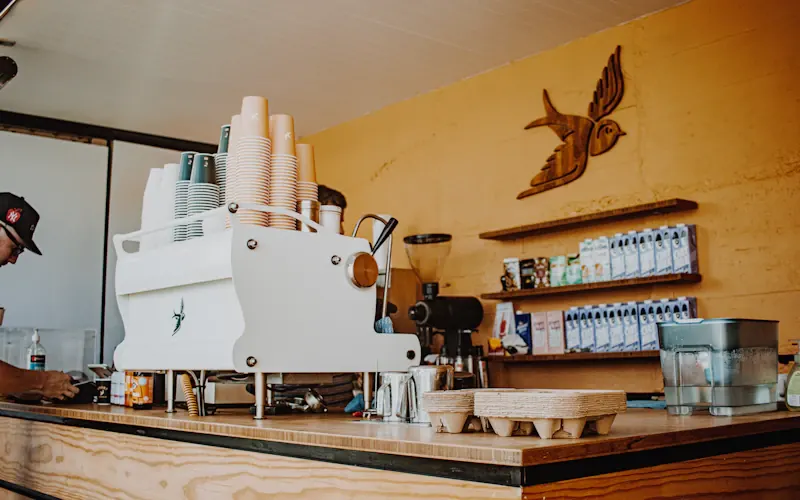
- Belgium has built a lively specialty coffee scene for its size. Whether you are a traveller discovering the country for the first time or a new resident looking for…
- Across Europe, Belgium has followed the third-wave movement that the Nordic countries pioneered…
- The country's linguistic diversity (French, Dutch, German, and English all functioning in parallel) also means that Belgian specialty coffee professionals are well-connected…
Belgium has built a lively specialty coffee scene for its size. Whether you are a traveller discovering the country for the first time or a new resident looking for your daily cup, this guide will help you navigate the specialty coffee landscape city by city, and more importantly, help you identify the real thing when you see it. We do not list specific addresses (establishments come and go), but we give you the tools to recognise quality wherever you find it.
What does "specialty coffee bar" actually mean?
The term "specialty" refers to a specific standard: coffee beans that score 80 or above on the Specialty Coffee Association's 100-point quality scale. In practice, a specialty coffee bar is one that sources its coffee exclusively or primarily from roasters working with such beans, prepared by trained staff using equipment and techniques designed to express the coffee's potential.
In Belgium, the bars that genuinely live up to this description share a common language: named roasters, transparent origins, menus that reflect coffee knowledge rather than marketing copy, and a tangible sense that the people behind the counter care about the result in your cup.
Why does Brussels have Belgium's densest and most diverse coffee scene?
Brussels is home to what is probably the most concentrated specialty coffee scene in Belgium, driven by its international population and a long tradition of demanding food and drink culture. The European quarter, the communes of Ixelles and Saint-Gilles, and the historic centre have all seen a strong growth of independent coffee bars since the early 2010s.
What makes Brussels distinctive is the diversity of its offer. You will find bars that roast on-site, bars that rotate frequently between roasters from Belgium and abroad, bars that focus on filter brewing, and bars that combine espresso excellence with natural wine, a pairing that feels very Brussels. The scene is also culturally permeable: English, French, and Dutch are all spoken, which means that as a visitor, you can almost always ask questions and get a real answer.
Brussels specialty bars tend to be concentrated in specific neighbourhoods. A good strategy is to find the social media accounts of Belgian roasters like MOK, their "find us" or partner bar lists will point you directly to the best spots in the city.
What makes daily specialty coffee culture so deep-rooted in Ghent?
Ghent has arguably the strongest everyday specialty coffee culture of any Belgian city. The large student population of Ghent University (one of Belgium's biggest) created a sustained demand for quality "third place" cafes, spaces that are neither home nor office but somewhere you want to spend a few hours. Ghent's specialty bars responded by developing a culture of hospitality that goes beyond the cup: long opening hours, food that pairs well with coffee, music that does not overwhelm conversation.
Ghent is also notable for its strong filter coffee culture. V60, Chemex, and cold brew are menu regulars rather than curiosities, reflecting a clientele that has educated itself about brewing methods. Many independent bars have developed their own identities there.
How did Caffènation shape Antwerp's specialty coffee scene?
Antwerp has a remarkable density of specialty coffee bars relative to its size. Much of this can be traced to the influence of Caffènation, a coffee bar and roaster based in Antwerp since the mid-2000s and long cited as a local benchmark. Its influence helped build a network of technically proficient, coffee-serious spots that raised the overall standard.
Antwerp's design and fashion identity bleeds into its coffee culture: bars are often visually striking, with strong aesthetic identities. But substance follows form, the quality in the cup tends to match the quality of the space. The city's central areas and the trendier southern districts are the best hunting grounds for specialty experiences.
What defines Liège's developing, distinctly Walloon coffee scene?
Liège is one of the French-speaking centres of Belgian specialty coffee. The city's scene is smaller than Brussels or Antwerp but growing in coherence. Bars in Liège often take a more educational approach, menus explain origins and methods, which is a positive indicator of genuine positioning rather than trend-chasing.
If you are visiting Liège for the first time, the specialty scene is worth exploring as a contrast to the city's more traditional café culture. The juxtaposition of classic Belgian brasseries and new-wave specialty bars gives Liège a coffee landscape that is transitional in an interesting way.
How do you spot a great specialty coffee bar?
| What to look for | What it tells you | Good sign | Warning sign |
|---|---|---|---|
| Roaster and origin displayed | Transparency and traceability | Named roaster, country/region visible | "House blend" with no source |
| Scale on the counter | Extraction precision | Barista weighs consistently | Scooping without measuring |
| Filter brewing options | Breadth of coffee culture | V60, Chemex, Aeropress on the menu | Espresso and cappuccino only |
| Quality burr grinder | Grind consistency | Visible precision grinder | Pre-ground coffee or blade grinder |
| Staff knowledge | Training and passion | Can describe the coffee's origin and flavour | Cannot answer basic questions |
| Menu clarity | Clear positioning | Concise, well-considered menu | Industrial syrups prominently featured |
Where does Belgium stand in European specialty coffee?
Across Europe, Belgium has followed the third-wave movement that the Nordic countries pioneered and that later reached the Netherlands, the UK and Germany. What gives Belgium a particular edge is the crossover with its celebrated beer and chocolate culture: Belgian consumers have long been trained to appreciate fermentation, complexity, and craftsmanship in food and drink. Specialty coffee fits naturally into that cultural framework.
The country's linguistic diversity (French, Dutch, German, and English all functioning in parallel) also means that Belgian specialty coffee professionals are well-connected internationally, reading publications and attending events in multiple languages, which keeps the scene porous and current.
The best way to explore Belgium's specialty coffee scene is with curiosity and no agenda. Walk into a bar that looks serious, ask what they are currently pouring, and follow the barista's recommendation. The quality is there. You just have to be willing to discover it on its own terms.
What should you expect on your first specialty coffee bar visit?
First-time visitors to specialty coffee bars sometimes find the experience unexpectedly different from commercial café culture, the menu is shorter, the staff engagement is higher, and some familiar options may be absent or offered differently than expected. Understanding these differences as reflections of a coherent philosophy rather than arbitrary restriction makes the first specialty bar visit considerably more enjoyable.
The shorter menu at a specialty coffee bar reflects a deliberate focus on quality over range. A commercial café may list a long run of espresso-based beverages, while a specialty bar usually keeps a shorter menu: a few milk-based drinks, possibly a choice of coffee, and filter options alongside espresso. This narrowing allows the bar to do fewer things with greater skill and attention: each drink on the menu has been considered, tested, and refined rather than added to fill a format expectation. When a specialty bar offers only two espresso bases, the house blend and a rotating single origin, it is presenting a considered choice rather than admitting a limitation.
The coffee selection and rotation at good specialty bars changes more frequently than commercial cafés: a "menu of the week" for guest single origins, seasonal rotating filter options, and periodic introduction of new coffees from roasters the bar is exploring. This rotation is oriented toward discovery, it assumes customers are curious about coffee's diversity rather than attached to a fixed taste profile. Asking the barista "what's on filter this week and what does it taste like?" is not an unusual question; it is the kind of engaged interaction that specialty bars are built around. Baristas in well-trained specialty bars are prepared to describe origin, processing, and flavour notes in accessible terms and to offer a taste before commitment if the coffee's character is unfamiliar.
Milk alternatives at Belgian specialty bars have become far more common in recent years. Oat milk, in several barista-specific formulations optimised for steaming and latte art, is now widely offered. Soy, almond, and coconut milk are widely available. The specialty bar approach to milk alternatives is typically that each alternative has a different interaction with espresso, oat milk being generally closest to dairy milk in steaming and blending behaviour, and staff can advise on which alternative works best for which drink if asked. Specialty bars rarely treat milk alternative requests as inconveniences; the category's growth has been accommodated with the same care applied to the coffee itself.
How does specialty coffee character differ across Brussels, Ghent, Antwerp and Liège?
Each of Belgium's main cities has developed a distinct specialty coffee character that reflects both the demographics of its specialty consumer base and the personalities of the pioneering operators who established the category in each urban context.
Brussels has the most cosmopolitan and diverse specialty scene, reflecting the city's international population and its position as the de facto capital of European institutions. The Brussels specialty consumer includes EU professionals with coffee reference points from multiple countries, international students and residents, and a growing local population that has developed sophistication through the scene's maturation. Brussels specialty bars tend toward international reference points, Nordic light-roast aesthetics, Japanese precision, Italian espresso tradition, rather than a single house style. The density of specialty options is highest in the Ixelles, Saint-Gilles, and Sablon neighbourhoods, with outposts throughout the 19 communes that give the Brussels specialty scene geographic reach unusual for a city of its size.
Ghent's specialty scene is more cohesive and perhaps more pedagogically oriented than Brussels. The university city's population of students and young professionals has supported specialty bars with strong educational missions, menu design that explains processing methods, staff who engage proactively about origin and brewing, tasting menus that invite comparison rather than default consumption. The Ghent specialty bar as a learning environment has created a consumer base that arrives with questions rather than assumptions, which in turn enables operators to present more adventurous coffees with confidence that the audience will engage rather than retreat to familiar territory.
Antwerp's specialty identity is most closely linked to the city's design and fashion culture. Specialty bars in Antwerp often position coffee within a broader aesthetic vision, the space, the service, the ceramics, the light, with a care for visual communication that matches the coffee quality. This is not superficiality: the design commitment reflects genuine investment in all aspects of the experience, and Antwerp specialty consistently produces some of Belgium's most carefully executed espresso service. The city's specialty scene has benefited from Caffènation's influence as a pioneering roaster and café.