☕ Key takeaways
- Rwanda's specialty output is overwhelmingly washed Red Bourbon handled by cooperative washing stations, which carry lot quality and traceability across the country's coffee supply chain. Naturals and honeys exist but remain a small share of exports.
- After the 1994 genocide, Rwandan specialty coffee became a lever for economic reconstruction, today Rwanda is one of Africa's most awarded coffee origins internationally.
- The typical Rwandan cup profile: bright acidity (citrus, red currant), medium body and floral sweetness, often compared to Kenya but with more roundness and less sharp phosphoric bite.
Rwandan Coffee Guide: Washed Bourbon, Cooperative Washing Stations
What should you remember about Rwandan coffee?
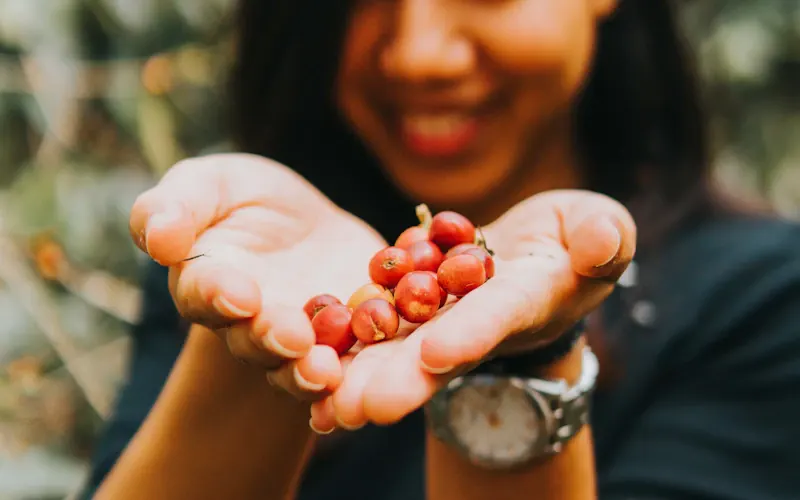
- A small landlocked country in Central Africa, Rwanda has become in under two decades an origin that specialty roasters actively seek, thanks to altitude, Red Bourbon and meticulous washed processing.
- Since 1994, coffee has been a lever for rural reconstruction: washing stations, trained agronomists, cooperatives and, in 2008, the first Cup of Excellence held in Africa.
- In the cup it is floral, fruity and lively, and a paper-filter brew such as V60 or Chemex serves that profile best.
Rwanda's rise to specialty coffee prominence is one of the most remarkable stories in the modern coffee world. A small, landlocked country in Central Africa, with no coastline, a GDP devastated by the 1994 genocide, and a coffee history rooted in colonial compulsion, has, in less than two decades, become one of the most sought-after origins for specialty roasters worldwide. The engine of this transformation: an exceptional combination of terroir (altitude, volcanic soil, Red Bourbon variety), processing infrastructure (cooperative washing stations), and structural reform. This guide explains how it all fits together and how to find the best lots.
How did a forced colonial crop become world-class coffee?
German missionaries brought coffee to Rwanda in 1904, planting the first trees at the Mibirizi mission in what is now Rusizi district. The place name stuck to a local variety, Mibirizi, still catalogued by World Coffee Research, which places it in the Bourbon-Typica group and notes that its exact origin remains poorly documented. When the territory passed to Belgian administration after the First World War, cultivation became compulsory: farmers had to plant coffee whether or not it suited them, and the colonial priority was planted area rather than what ended up in the cup. The legacy is double-edged, millions of Red Bourbon trees scattered across the hillsides, and decades of volume-first habits that took a generation to unlearn.
After the genocide in 1994 the industry was in ruins, with barely a functioning washing station left in the country. The Kagame government identified coffee as a strategic vector for rural development and export diversification. From 2000, the USAID-funded PEARL project, run with the National University of Rwanda, Michigan State University and Texas A&M, financed the first modern washing stations, trained agronomists and helped farmers organise into cooperatives that could negotiate directly with international buyers. In 2008 Rwanda became the first African country to host a Cup of Excellence, the origin competition run by the Alliance for Coffee Excellence, and the origin has been on specialty buying lists ever since.
Which Rwandan provinces grow which coffee profiles?
Rwanda is often called the "land of a thousand hills", and the phrase is more than tourism copy. Broken terrain produces a patchwork of microclimates, and the bulk of the country's coffee sits between 1,400 and 2,000 m, high enough for slow cherry maturation and concentrated sugars. Roughly two hundred central washing stations serve those hills, unevenly spread between provinces. Key regions:
- Northern Province (Musanze, Burera). Proximity to the Volcanoes National Park. Volcanic soil, altitudes to 2,000 m. Exceptionally intense floral notes.
- Western Province (Nyamasheke, Rusizi). Lake Kivu shoreline. Lake-influenced microclimates, more citrus-forward profiles.
- Southern Province (Huye, former Butare). Historical production zone, moderate altitude (1,500-1,700 m), softer and more balanced cups.
- Eastern Province (Kayonza). Lower altitude, different profile, less represented in high-end specialty.
Why does Red Bourbon still dominate Rwandan farms?
Bourbon is a natural mutation of Typica that emerged on the island of Bourbon (today Réunion) after the French East India Company shipped Yemeni seedlings there between 1708 and 1718. It is widely considered one of the arabica varieties with the most complex and elegant aromatic potential. In Rwanda:
- Red Bourbon remains dominant, a fortunate accident of history rather than deliberate preservation.
- It is moderately productive but intrinsically high-quality, offering characteristic sweetness, florals and clean fruit.
- It is susceptible to coffee leaf rust and the coffee berry borer, which is why many other origins have shifted to disease-resistant hybrids.
- Yellow Bourbon exists in small quantities; the Jackson variety (an early-ripening local mutation) appears in rare micro-lots.
How is Rwandan coffee washed, fermented and dried?
Almost all quality Rwandan coffee is fully washed. The process:
- Selective hand-picking. Only fully ripe red cherries are harvested. Farmers deliver their cherries to the local washing station, typically in the evening or early morning to prevent fermentation during transport.
- Flotation sorting. Cherries are floated in water tanks; hollow or underripe cherries float and are removed.
- Mechanical depulping. Cherries are depulped within hours of delivery to prevent uncontrolled fermentation.
- Wet fermentation. Parchment coffee ferments for 24-48 hours in clean water to break down mucilage.
- Multi-stage washing. Coffee is rinsed through multiple channels with fresh mountain water.
- Raised bed drying. Parchment coffee dries on elevated wire mesh beds, first in shade (to avoid thermal shock), then in sun, for 2-3 weeks depending on conditions.
The washing station is the central node of Rwandan quality. It handles traceability (each farmer delivery is logged), process control, and the commercial relationship with international importers.
What does Rwandan coffee taste like in the cup?
| Characteristic | Typical description | Comparison |
|---|---|---|
| Acidity | Bright, clear, malic to citric | Similar to Kenya but gentler |
| Body | Light to medium | Lighter than Ethiopian Yirgacheffe |
| Floral notes | Hibiscus, jasmine, rose | Bourbon's distinctive floral signature |
| Fruit notes | Blackcurrant, red berry, strawberry, citrus | Softer and more delicate than Kenyan black fruit |
| Sweetness | Good lingering sweetness | Brown sugar, light honey |
| Ideal roast | Light to medium | Preserve florals and fruit |
What is the potato defect, and should it worry you?
The "potato defect" runs across the Great Lakes region rather than Rwanda alone: Burundi, Uganda and the Democratic Republic of Congo see it too. It shows up as a raw potato smell in the cup, and a single affected bean is enough to ruin an entire shot or pour-over. The compound responsible has been pinned down, 2-isopropyl-3-methoxypyrazine, which is present at dramatically higher concentrations in defective green beans. The pathway is less settled. The dominant explanation ties the defect to cherries punctured by the Antestiopsis bug, which opens the fruit to microbial colonisation, but the literature still divides between a bacterial and a fungal agent. Either way, nothing about the bean gives it away, green or roasted.
A serious roaster working Rwandan coffee mentions this rather than hiding it. In practice the incidence on well-sorted station lots is low. If it does appear in yours, it is not a brewing error: it is a terroir hazard that Rwandan producers are pushing down through intensive hand-sorting, Antestiopsis control and fast depulping after delivery.
What should a Rwandan coffee label tell you?
- Washing station named. The washing station name on the label signals real traceability.
- Province or commune identified. Musanze, Burera, Nyamasheke, Huye are meaningful geographic identifiers.
- Red Bourbon variety stated. Confirms the roaster has done sourcing homework.
- Washed process confirmed. Nearly all quality lots are washed; if the process is absent from the label, ask.
- Recent harvest. Rwanda's main harvest runs from March through July, peaking April to June. Look for lots less than 18 months post-harvest.
- Flavour notes consistent with origin. Hibiscus, blackcurrant, jasmine, citrus are expected. Smoky or peanut notes signal over-roasting.
Rwanda shows that world-class coffee does not require centuries of history. It needs honest terroir, thoughtful infrastructure and producers who understand that quality is a long-term investment. This small country understood that faster than most.
Which brew method suits Rwandan coffee best?
Rwanda expresses itself best through paper filter methods that retain oils and allow the floral and fruit aromatics to shine:
- V60. Ratio 1:15 to 1:16, water at 93-94°C, medium-fine grind. 30-second bloom at 2× coffee weight. Total drawdown 3-3:30 min.
- Chemex. Ratio 1:16. The thick Chemex filter adds even more clarity. Water at 92°C for light roasts.
- AeroPress. Inverted method, 1:12 to 1:14, 4-minute contact, excellent for revealing the more subdued body.
- Espresso. Possible but demanding. Lightly roasted Rwandan Bourbon needs higher temperature (94-95°C) and a longer ratio (1:2.5) to avoid sharp acidity.
Why do washing stations behave like quality brands in Rwanda?
Rwandan specialty quality is inseparable from the country's network of washing stations, the centralised facilities where smallholders deliver their cherry. The model explains two things at once: the consistency that makes Rwandan coffee dependable on a buying list, and the specific character that processing conditions stamp on the cup.
Scale is the starting point. Rwandan households farm small plots, which yields enough cherry to be worth delivering and nowhere near enough to justify a pulper and drying beds of one's own. Stations therefore aggregate deliveries from many smallholders and process them in one place: machine depulping, mucilage broken down in fermentation tanks, washing through channels, then drying on raised tables for a matter of weeks. Centralising all of that makes fermentation time, water quality and drying conditions controllable, which farm-level processing cannot deliver at this plot size.
The consequence is that the best stations have become quality brands in their own right. Gatare and Mutovu in Nyamasheke, or Buf Café in the Southern province, founded by Epiphanie Mukashyaka, are names specialty buyers look for on a label. Their reputation rests on fermentation management and drying protocol as much as on terroir, which is why buyers who know the market specify a station name alongside, or instead of, a region.
Processing diversity arrived late and remains modest. Washed lots define the origin's reputation, while naturals, honeys and anaerobic lots make up a small share of output, even if interest in them is growing. A natural Rwandan Bourbon dried on raised beds keeps the variety's brown-sugar sweetness and adds a layer of fruit that the washed route deliberately strips out.
What does Rwanda's Bourbon monoculture mean for flavour and risk?
Rwanda leans on Bourbon to a degree that is unusual among producing countries. Colombia diversified into disease-resistant hybrids after its rust crisis; Ethiopia rests on an extraordinary base of wild and landrace arabica populations. Rwanda kept a comparatively pure Bourbon genetic base, and that single decision, or rather that absence of decision, drives both its quality advantage and its exposure.
In Rwandan highland terroir the variety expresses itself with unusual consistency: clean sweetness read as brown sugar or caramel, a citric and malic acidity that comes across as orange or red fruit under washed processing, body that holds its own against that acidity, and a long clean finish. Experienced tasters often recognise a washed Rwandan Bourbon within a few sips.
The exposure is equally real, and it sharpens as the climate shifts. Bourbon is susceptible to coffee leaf rust (Hemileia vastatrix), the disease that swept Colombian arabica between 2008 and 2013 and hit Central America hard in 2012 and 2013. Rwanda has so far avoided an epidemic of that scale. Altitude helps, since rust thrives in warmer, lower-lying regions, but warming erodes that cushion. Replanting with resistant material would protect yields, yet it would also dilute the pure-Bourbon signature that buyers pay for, and that tension is the strategic question facing the origin.