☕ Key takeaways
- Peru is the world's leading exporter of certified organic coffee, with roughly 90,000 hectares certified out of 335,000 hectares harvested (USDA FAS annual report, 2025). Cajamarca, San Martín and Junín account for most of the crop.
- Peruvian coffees are predominantly washed with clean, balanced profiles: dried fruit, caramel and gentle acidity, less intense than Kenya or Ethiopia, but very accessible and consistent.
- Typica covers around 70 percent of planted area and Caturra around 20 percent. Catimor spread after the leaf rust epidemic of 2012 and 2013, and quality-focused farms are now moving back toward Bourbon and Pache.
Peruvian Coffee Guide: Cajamarca, San Martín, Chanchamayo
What are the three key takeaways on Peruvian coffee?
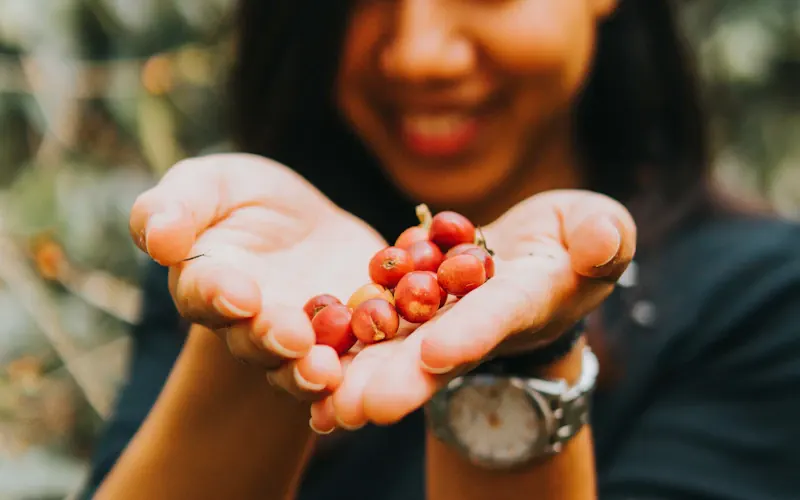
- Peru sits ninth among coffee exporters worldwide and first in certified organic, yet it rarely gets the attention that combination should earn.
- Almost everything is washed: depulped at the farm or the cooperative mill, fermented for a day or two, then sun-dried on raised beds or patios. That is where the cup clarity comes from.
- Region, altitude, cooperative and roast date on the label. Four data points, and the "Peru organic" sticker on its own is not one of them.
Peru is one of coffee's best-kept secrets. On the International Coffee Organization's 2022 to 2024 average it ranks ninth among coffee exporters worldwide, and first of all on certified organic, yet it rarely gets the attention it deserves from European specialty consumers. Part of that is history, Peru's chaotic commercialisation, the Shining Path years, broken supply chains, and part of it is simply size: the coffee-growing zones stretch across hundreds of kilometres of the Andes, producing a dizzying variety of profiles depending on which valley you are in. But here is the thing: once you taste a well-sourced Cajamarca or a carefully separated San Martín lot, you wonder how this origin ever stayed under the radar. This guide is your entry point.
How did Peru become a cooperative coffee country?
Coffee arrived in Peru in the eighteenth century via colonial trade routes, planted first in coastal regions then pushed progressively eastward into the high-jungle slopes of the Andes, the ceja de selva, as colonists and missionaries opened new territories. Production remained marginal until the nineteenth century, when British and German investors developed large coffee haciendas in the Chanchamayo and Cusco valleys.
The twentieth century brought upheaval. General Velasco's 1969 agrarian reform dissolved the great haciendas and redistributed land to peasant communities, a radical shift that created the conditions for the cooperative model dominating Peruvian coffee today. Cooperatives, strengthened in the 1990s by organic and fair trade certifications, became the backbone of Peruvian coffee exports. Peru's cooperative movement is now one of the most studied in the world as a case of sustainable agricultural development.
One more shock shaped the varieties in the ground. The coffee leaf rust epidemic that broke out in 2012 and 2013 hit around 40 percent of Peru's crop according to the USDA FAS annual report published in 2025, and pushed a great many growers toward rust-tolerant Catimor. Peru is still working its way back from that trade-off.
What is the ceja de selva, and why does coffee grow there?
Peruvian coffee grows in the ceja de selva, literally "the eyebrow of the forest", a narrow, vertiginous strip of land between the high Andes and the Amazon rainforest. Coffee is farmed in 17 of Peru's 24 regions along that strip. Most volume comes from between 1,000 and 1,800 m, with the highest plots reaching about 2,100 m in the north, and east- and west-facing Andean slopes offering very different exposures and rainfall patterns.
This is difficult, fragmented terrain. World Coffee Research counts more than 202,000 coffee farms in the country, averaging a little over one hectare each, and smallholders supply the great bulk of national output. That fragmentation is both a logistical challenge and a source of diversity, since each micro-valley can produce a coffee with its own fingerprint. Cooperatives play a key aggregating role, pooling lots from dozens or hundreds of small producers to reach exportable volumes, though a large share of Peruvian growers still sell outside any cooperative, to local intermediaries.
What makes Cajamarca coffee taste the way it does?
In the northern Andes, Cajamarca is both Peru's leading producing region, at roughly 22 percent of the national crop, and the showcase for its specialty sector. The growing provinces cover a wide altitude band: Jaén and San Ignacio run from about 900 to 1,950 m, while Cutervo, a newer area converted from sugar cane, climbs toward 2,100 m. Soils are rich, slightly acidic and well-drained, favourable conditions for slow cherry ripening.
Cajamarca coffees stand out for their remarkable softness: medium to silky body, gentle enveloping acidity, aromas of hazelnut, white chocolate and caramel, with red and yellow fruit showing on the better-sorted lots. This accessible yet elegant profile makes it an excellent entry point into Peruvian specialty, and a reliable comfort brew for mornings that call for something gentle. Cajamarca is also home to CENFROCAFE, founded in Jaén in 1999 and now one of the country's reference cooperatives for specialty buyers.
Is San Martín coffee worth seeking out?
San Martín is Peru's second producing region at around 20 percent of the crop, just behind Cajamarca, concentrated in the Mayo and Huallaga river valleys at generally modest altitudes, roughly 900 to 1,200 m. Warmer and more humid than the north or centre, these conditions give coffees a medium body, frank acidity and notes of chocolate, nuts and caramel, with a sweetness that reveals itself beautifully in a pour-over brewed at the lower end of the temperature range.
San Martín carries a remarkable social history: in the 1980s and 1990s it was one of Peru's main coca-growing zones, controlled by the Shining Path. The shift toward coffee, supported by international alternative development programmes, transformed entire communities. The Oro Verde cooperative, started in Lamas in 1999 by 56 members and now grouping more than a thousand producer families, is the case most often cited. The cup you drink carries that story.
Why is Chanchamayo called Peru's original coffee valley?
Chanchamayo, in the Junín region, is Peru's historical coffee heartland, known since the colonial hacienda era. This is where nineteenth-century European investors put the first plantations of any scale, and the cooperative fabric here is correspondingly old: CAC La Florida was founded in 1966 by fifty smallholders. Junín now accounts for roughly 19 percent of national output.
The valley, between 900 and 1,800 m, produces a more classic profile: caramel, gentle citrus (orange, mandarin), light body, good cleanliness in the cup. It is a balanced, approachable coffee, no sharp edges, which often works well as a first step for those transitioning from commercial to specialty. Some producers in Chanchamayo are also beginning to experiment with honey and natural processing to access premium markets with differentiated flavour profiles.
Which varieties and certifications will you see on a Peruvian bag?
| Variety | Flavour profile | Regions |
|---|---|---|
| Typica | Soft, floral, delicate, low yield. Around 70% of planted area, known locally as Nacional | Cajamarca, Cusco |
| Caturra | Lively, citrus, clean acidity. Around 20% of planted area | Chanchamayo, San Martín |
| Bourbon | Sweet, body, chocolate, hazelnut | Cajamarca, Cusco, Puno |
| Catimor | Robust, less complex, rust-resistant | All regions (commercial) |
| Pache | Typica mutation, sweet and low in acidity, creamy mouthfeel | Cutervo (Cajamarca) |
Peru is the world's top exporter of certified organic coffee, with about 90,000 hectares certified out of 335,000 harvested, per the USDA FAS annual report published in 2025. This certification, championed by large cooperatives and agricultural development NGOs, guarantees the absence of pesticides and chemical fertilisers. It is often paired with Fairtrade or Rainforest Alliance. For the conscious buyer, a certified Peruvian organic offers real environmental and social guarantees, as long as you verify the certification is current and active, not a recycled label on an old bag.
Why is nearly all Peruvian coffee washed?
Almost all Peruvian coffee is processed washed. Cherries are depulped at the farm or at the cooperative's central processing station, fermented in tanks for 24-48 hours depending on the local climate, then washed thoroughly and dried in the sun on raised beds or patios. The cup clarity that results is one of Peru's greatest assets: few intrusive notes, clean terroir and variety expression. Peruvian coffees shine brightest in pour-over (V60, Chemex, Kalita Wave) at 90-93°C. Their softness and moderate body also make them excellent in a French press or a short, concentrated AeroPress recipe.
How do you buy a Peruvian coffee that is actually good?
The main pitfall with Peruvian coffee is over-generalisation. "Peru organic" on a supermarket bag says nothing about intrinsic grain quality, production altitude or freshness. Specialty roasters who work seriously with Peru always specify the region, altitude, cooperative or producer, and roast date. That is the only way to ensure the "organic" or "specialty" premium is real, not cosmetic.
For a sense of scale on price: green Peruvian coffee exported over the 2024/25 season averaged 229 US dollars per 60 kg bag, about 3.80 dollars per kilo, up 28 percent year on year (USDA FAS annual report, 2025). That is the farm-gate-to-port figure, long before freight, roasting and retail margin, and it is a useful reminder that the premium on a traced lot is not invented at the shop counter.
Worth noting for readers buying in Europe: Belgium is Peru's third export destination at 11 percent of shipments, behind the United States at 27 percent and Germany at 19 percent. The origin travels much closer to home than its low profile suggests.
Peru produces some of the softest, most approachable coffees in the specialty world. Its low profile on European markets is an anomaly that is steadily correcting itself, explore it now, before the prices align with the quality.
What can a cooperative do that a single smallholder cannot?
Peru's specialty coffee development has been built primarily through cooperative structures rather than the large private farm model characteristic of some competing origins. Understanding the cooperative model's strengths and limitations explains both why Peruvian specialty has developed the way it has and what its quality ceiling looks like.
Peru's coffee smallholders, most of them working farms under five hectares in Cajamarca, San Martín and Junín, lack individually the volume and capital to access specialty export markets, negotiate direct with international buyers, or invest in the processing infrastructure (wet mills, raised drying beds, climate-controlled drying facilities) that specialty quality requires. Cooperatives aggregate the volume needed to fill a shipping container, share the cost of processing infrastructure, and provide the organisational capacity to engage with certifiers, buyers and development agencies.
The cooperative model creates quality management challenges that private farms with centralised processing avoid. When cherries from dozens or hundreds of member farms are aggregated, the quality discipline of the weakest member affects the collective lot. Cooperatives that have successfully navigated this challenge have done so through tiered membership systems, separating members who consistently achieve quality benchmarks into distinct processing streams that receive premium prices, while providing technical training and graduated standards for members working toward the same benchmarks. This tiered approach creates economic incentives for quality investment among individual farmers rather than relying on cooperative-level quality management alone.
The most established Peruvian cooperatives, CENFROCAFE in Cajamarca, Oro Verde in San Martín, Pangoa and La Florida in Junín, have built long relationships with specialty buyers that provide the price certainty enabling member investment in organic certification, shade tree management and selective harvest practices. Their founding dates say something about the depth of that base: La Florida in 1966, Pangoa in 1977, Oro Verde and CENFROCAFE both in 1999. These relationships have turned organisations that began as collective marketing vehicles into genuine quality development institutions with technical training staff, processing laboratories and cupping programmes that evaluate member harvests systematically rather than accepting cherries at face value.
Does organic certification tell you anything about cup quality?
Peru leads the world in certified organic coffee exports, a position that reflects both genuine agricultural practice and the economic calculus of organic premium access. Understanding what organic certification means in the Peruvian context, and how it interacts with specialty quality, helps evaluate Peruvian coffees in the market more accurately.
The geographic reality of most Peruvian coffee farming supports organic production naturally: farms in remote highland regions of Cajamarca, San Martín, and Chanchamayo are frequently isolated from agrochemical supply chains, making synthetic fertiliser and pesticide use economically impractical regardless of certification intention. The result is that many Peruvian farms were effectively "organic by default" before formal certification, not from philosophical commitment to organic agriculture but from logistical constraints on accessing conventional inputs. Formal organic certification converted this default practice into a market premium without requiring significant practice change for most members.
The quality implications of organic certification in Peru are complex. Shade-grown, organic farms in the highlands that have invested in soil health through compost, legume cover crops, and tree management often produce coffees with the mineral complexity and cup clarity that specialty buyers seek. But organic certification alone does not guarantee quality, a neglected, organically certified farm can produce low-quality cherries that score poorly regardless of certification status. The most reliable quality signal in Peruvian specialty remains the cupping score together with the specific cooperative or farm provenance, with organic certification as a supporting indicator of cultivation care rather than a quality guarantee in itself.
The export supply chain for certified organic Peruvian coffee involves documentation overhead that cooperatives with international market experience navigate efficiently but that adds cost to smaller or less established operations. International buyers purchasing Peruvian organic specialty directly from cooperatives must verify the chain of custody documentation, from farm through wet mill through dry mill through export, that justifies the organic certification at the retail level. The best Peruvian cooperative exporters maintain this documentation systematically and can provide it rapidly, which has become an increasingly important criterion as certification fraud in organic supply chains has attracted regulatory attention in European and North American markets.