☕ Key takeaways
- Panama is world-famous for the Geisha (Gesha) variety, with lots from Hacienda La Esmeralda setting global auction price records that redefined what coffee could be worth.
- The Boquete region (Chiriquí province), at 1,200 to 1,800 m and wrapped in the bajareque mist that keeps daytime temperatures down, provides ideal conditions for Geisha expression.
- Panamanian washed Geisha delivers a unique floral profile (jasmine, bergamot, passion fruit) difficult to find in any other origin, its high price reflects genuine rarity, not branding.
Panamanian Coffee Guide: Boquete, Geisha, World Reference Prices
What are the three key takeaways on Panamanian coffee?
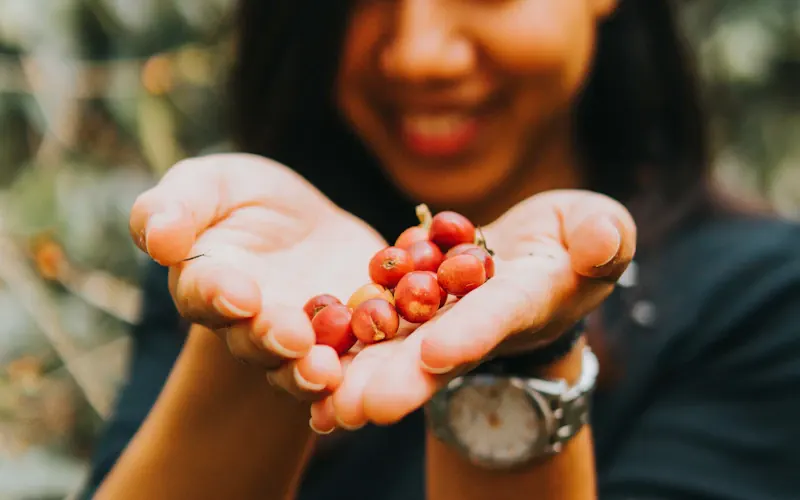
- Panama has the smallest coffee-growing area in Central America, yet it has become the most influential origin in terms of price and prestige. One word explains it: Geisha. This…
- The Panamanian Geisha market operates across several price levels corresponding to very different quality and traceability tiers. At the top, Best of Panama auction lots reach…
- The golden rule is full traceability. A quality Geisha must indicate: the farm or producer name, the exact region (Boquete preferred, or Volcán), altitude, processing, confirmed…
Panama has the smallest coffee-growing area in Central America, yet it has become the most influential origin in terms of price and prestige. One word explains it: Geisha. This arabica variety with its extraordinary floral aromatics, revealed to the world at the Best of Panama competition in 2004, shattered every coffee auction record and transformed a small tropical country into the global epicentre of luxury coffee. Today, a natural-processed Geisha from Boquete can fetch thousands of dollars per kilogram at the green stage. This guide cuts through the mythology: where does the Geisha come from, what justifies its price, how do you recognise a genuinely high-quality Geisha, and how do you buy one without being swept away by the marketing?
How did a forgotten hedge plant turn into the world's most expensive coffee?
The Geisha variety originates from the Gesha (or Gecha) region of Ethiopia, from which it takes its name. Seed reached the Centro Agronómico Tropical de Investigación y Enseñanza (CATIE) in Turrialba, Costa Rica, in 1953 under accession number T2722, and was sent on to Panama in 1963, largely in the hope that it would stand up to coffee leaf rust. Growers found it too unproductive to bother with and planted it as a windbreak hedge and ornamental on a handful of mountain farms. There it sat, almost forgotten, for four decades.
The turn came in 2004. The Peterson family entered a washed Geisha from Hacienda La Esmeralda, above Boquete, in the Best of Panama competition, run annually since 1996 by the Specialty Coffee Association of Panama. The international panel found a floral intensity with nothing comparable in the rest of the table, and the lot sold at auction for $21 per pound, roughly $46 per kilogram. That was a world record for green coffee at the time, and it reset what a farm could expect to earn from a single micro-lot. Every edition since has either broken the ceiling or come close, and while those extreme prices touch only a sliver of national production, they have pulled the whole of Panamanian coffee upmarket.
Why does Chiriquí account for almost all of Panama's specialty coffee?
Almost all of Panama's quality coffee comes from Chiriquí province, in the west of the country, at the foot of Volcán Barú, Panama's highest peak at 3,475 m. The Barú creates an exceptional microclimate: stable cool temperatures, abundant but well-distributed rainfall, rich volcanic soils. This terroir is reminiscent in many ways of certain Ethiopian coffee-growing regions, which may partly explain why the Geisha variety, African in origin, adapted so perfectly here. Three growing districts are recognised within the province. Boquete, on the Barú's northern slopes, is the most celebrated: farms sit between 1,200 and 1,800 m in a landscape of rushing rivers and cloud forest, under the bajareque, a fine wind-driven mist off the Caribbean side that holds daytime heat down even in the dry season. Volcán, on the south-western face, produces quality coffee with a slightly different profile, often softer, with creamier notes. Renacimiento, further west toward the Costa Rican border, remains the quietest of the three.
What sets Geisha apart from other arabicas?
Geisha (Panama spelling) or Gesha (Ethiopian spelling) is an arabica variety with narrow long leaves and slender cherries, and a genetic profile that distinguishes it clearly from Bourbon or Typica. Its elongated habit and low fruit density per branch explain its low yields, often 30-50% below commercial varieties, which partly justifies its high producer-level price. What truly sets Geisha apart is its aromatic profile: grown at high altitude (above 1,500 m), with slow and careful ripening, it develops intense floral aromas (jasmine, geranium, bergamot, orange blossom) and a fine fruit palette (white peach, mandarin, passion fruit, lychee). In the cup, the texture is often light, close to tea, with bright acidity and very long aromatic persistence. It is a sensory experience radically different from "classic" coffee.
How does processing change the way a Geisha tastes?
| Processing | Resulting Geisha profile | Price level |
|---|---|---|
| Washed | Pure floral, precise citrus, tea texture, bright acidity | High |
| Natural | Intense tropical fruit, fermented sweetness, more body | Very high to exceptional |
| Honey | Floral-fruity balance, caramel, intermediate body | High |
| Anaerobic | Pronounced fermentation, unusual notes, polarising | Variable, often premium |
What do you actually pay for Panamanian Geisha?
The Panamanian Geisha market operates across several price levels corresponding to very different quality and traceability tiers. At the top, Best of Panama auction lots reach their record prices through institutional buyers: Asian specialty chains, Japanese and Korean collectors, prestige roasters. The most recent benchmark comes from August 2025, when a washed Geisha from Hacienda La Esmeralda scoring 98/100 went to a buyer in Dubai at $30,204 per kilogram; the weighted average across that auction was $2,861 per kilogram, on total sales above $2.8 million. The 2026 cuppings ran in late July, but the auction had not been settled as of early September 2026. These prices are real, they concern a few dozen lots a year, and they are not accessible to the general public. Below that sit "competition grade" lots that did not go through auction but are priced at €80-200/250 g at European specialty roasters. Then come "standard specialty" Geishas at €30-70/250 g, still expensive compared to other origins, but where the floral typicity is clearly perceptible. Finally, some coffees sold as "Geisha" below €20/250 g are often lower-grade Geisha grown at lower altitude or poorly processed, which do not deliver the expected experience.
Which other Panamanian varieties deserve attention?
While Geisha dominates the conversation, Panama also produces excellent coffees with other varieties: Bourbon, Typica and Caturra in Chiriquí's lower zones offer more classic, chocolaty and balanced profiles at much more accessible prices. These coffees deserve attention for their genuine quality, often eclipsed by Geisha's prestige. The Santa Clara region, in Chiriquí's eastern plains, produces commercial-grade coffee but accounts for the bulk of exported volume.
How do you spot a genuine Panamanian Geisha?
The golden rule is full traceability. A quality Geisha must indicate: the farm or producer name, the exact region (Boquete preferred, or Volcán), altitude, processing, confirmed Geisha variety (not just "Panama specialty"), and roast date. Without this information, the "Geisha" label is not a guarantee. Serious Belgian specialty roasters working with Panama often maintain direct relationships with farms and can justify every lot. This is not a daily purchase, it is an experience to plan for.
Geisha is not a morning espresso. It is a coffee to brew as a pour-over, at a low temperature (88-90°C), to be sipped slowly, like reading a great text. Rushing it is its greatest enemy.
Why isn't altitude enough to explain Boquete's reputation?
Panama's coffee reputation rests almost entirely on the Chiriquí province, and within Chiriquí, on the district of Boquete, a small valley below the Barú volcano that produces a disproportionate share of the world's most celebrated and expensive specialty coffees. Understanding what makes Boquete specifically exceptional (rather than simply "Panamanian") requires looking at the microclimate characteristics that operate independently of altitude.
Boquete sits at 1,200 to 1,800 metres, which is excellent but not uniquely high for Central American coffee production, Honduras, Guatemala, and Costa Rica all have farms at comparable or higher altitudes. What distinguishes Boquete is a combination of soil, humidity, and temperature stability that is unusually favourable for slow cherry ripening and flavour development. The valley's position relative to the Barú volcano creates a funnel effect for cool, humid air from the Caribbean side, which moderates daytime temperatures even during Panama's dry season. This cooling effect, combined with the volcanic soil's drainage and mineral richness, creates conditions where cherry ripening is extended and the accumulation of sugars and aromatic precursors is unusually thorough.
The low variability in temperature between day and night, smaller diurnal temperature range than many high-altitude coffee zones, is another Boquete specific factor. Larger diurnal ranges are often associated with quality in coffee and wine production because cool nights slow respiration and sugar loss after photosynthesis. Boquete's more moderate range might suggest disadvantage, but the compensating stability of conditions across the harvest season produces consistent cherry quality that erratic-temperature farms struggle to match. The coffee cherry that ripens slowly and consistently in stable humidity accumulates specific precursors that produce the floral and stone fruit notes associated with the best Panamanian coffees.
Volcán, the district on the opposite, south-western flank of Barú, produces a distinct profile from the Boquete valley. Volcán coffees tend toward more structured acidity and a mineral character attributed to younger, less weathered volcanic soil. Some producers label Boquete and Volcán lots explicitly, which lets a buyer compare the effect of exposure and soil age within the same province, an unusually instructive comparison given how little ground separates the two.
Is non-Geisha Panamanian coffee undervalued?
The Geisha variety's dominance of Panamanian coffee's international reputation has created a market distortion: buyers who associate Panama exclusively with Geisha miss the range of other varieties and processing styles that Boquete and Volcán producers have developed with serious investment and skill. Exploring non-Geisha Panamanian coffee reveals a broader origin identity worth understanding.
Caturra and Catuaí, the workhorses of Central American coffee production, produce very different cups in Boquete's microclimate than in more typical growing environments. The same variety that produces a serviceable but unremarkable cup at a Costa Rican cooperative at 1,400 metres may produce a notably more complex cup in Boquete's specific conditions. What buyers familiar with the origin describe is a particular sweetness and body that Boquete soil and climate impart to varieties which rarely express those characteristics elsewhere. Blind cupping of Boquete Caturra alongside equivalent Costa Rican and Guatemalan Caturra often reveals a quality premium that the Panamanian origin commands, even without Geisha prestige.
Natural and honey-processed Panamanian coffees represent the most undervalued segment of the market. Washed Geisha receives the most press; natural-processed Geisha commands the highest auction prices. But natural-processed Caturra or Catuaí from established Boquete farms at speciality scores of 84-87 points offer excellent value relative to their quality level, the Geisha halo affects all Panamanian coffee pricing upward, but more moderately for non-Geisha varieties. These coffees often show stone fruit and chocolate character in natural processing that resembles Costa Rican black honey without the volcanic-soil mineral edge, smooth, accessible, and rewarding as daily filter coffees.