☕ Key takeaways
- The moka pot works by steam pressure (1 to 2 bar): heated water in the lower chamber forces through the grounds and rises into the upper chamber, not espresso, but stronger than filter.
- Grind should be medium-fine (coarser than espresso), heat low and constant, and the finished coffee removed at the first gurgling sound to avoid over-extraction bitterness.
- The key technique upgrade: start with already-hot water in the lower chamber to shorten the heat climb and prevent the grounds from scorching during a prolonged heat-up.
Moka Pot Brew Guide: Pressure, Temperature, Perfect Roast
3 key takeaways
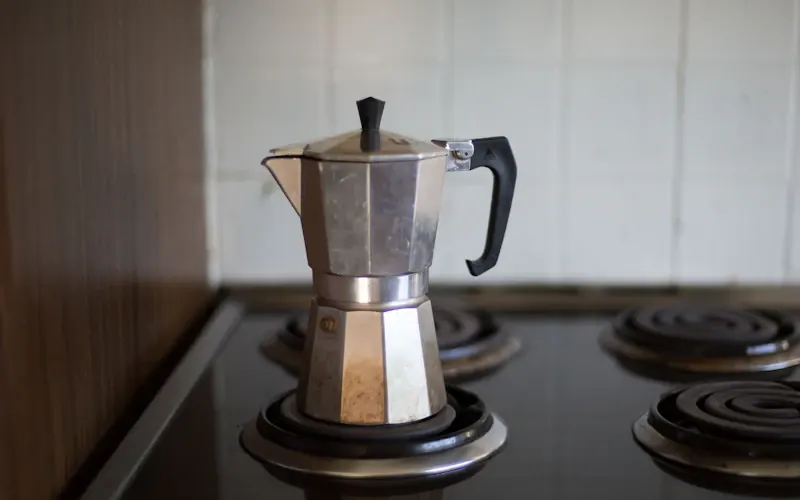
- The moka pot is the most common household brewing method in Italy. Alfonso Bialetti is credited with the 1933 invention, and his son Renato put it into industrial production under the Moka Express name from 1946 onwards.
- It is not an espresso machine. Pressure stays around 1 to 2 bar against 9 bar for espresso, which rules out crema but is more than enough for a concentrated, full-bodied cup.
- The moka pot excels with medium to dark roast blends, especially traditional Italian-style assemblages of Robusta and Arabica, whose chocolate, caramel and hazelnut character holds up at that concentration.
For the right pressure and a perfect roast, start with the right hardware.
Beginner: Bialetti Moka Express 3-cup, aluminium body, bakelite handle, the original design
Advanced: Bialetti Venus induction, stainless steel, works on every hob type
The moka pot is the most common household brewing method in Italy. Alfonso Bialetti is credited with inventing it in 1933, though it was his son Renato who turned it into an industrial product and sold it under the Moka Express name from 1946 onwards. Its octagonal aluminium silhouette has become a cultural symbol as much as a kitchen tool. Yet despite that reach, the moka pot is rarely used to its full potential. Most people end up with bitter, scorched, or metallic-tasting coffee not because of any fault in the device, but because of a handful of easily corrected technique mistakes. This guide fixes those habits and explains the physics behind the extraction.

How much pressure does a moka pot actually build?
Ready to choose? → See our comparison and current prices
The moka pot is not an espresso machine. It works at roughly 1 to 2 bar, against 9 bar for espresso. The driver is not steam alone: it is the mixture of trapped air and water vapour sitting above the water in the heated bottom chamber. As that mixture gains pressure it pushes liquid water up through the perforated basket holding the grounds, then through the central tube into the top chamber. Too little pressure for crema, more than enough for a dense, intense cup with a chocolatey and caramelised character.
Boiling is not the trigger, whatever the kitchen folklore says. Measurements published by Navarini and colleagues in Applied Thermal Engineering in 2009, on a three-cup Moka Express, record brewing starting with chamber water near 69 °C, and the liquid leaving the coffee bed cooler still: around 63 °C for the first drops, roughly 79 °C averaged across the pour. The same paper splits the brew into a regular extraction phase and a noisy final one it calls the strombolian phase, where steam and superheated water cross the bed together and dissolve exactly the compounds you do not want. Everything about good moka technique comes down to finishing before that second phase, and a hot-water start at 70 to 80 °C with a moderate flame is the simplest way to get there.
Which brewing variables matter most on a moka pot?
| Parameter | Optimal value | Common mistake |
|---|---|---|
| Starting water | Hot (70-80 °C) | Cold tap water |
| Water level | Below the safety valve | Overfilled (risk of overpressure) |
| Grind size | Medium-fine to fine | Too fine (pure espresso) or too coarse |
| Basket fill | Level to the top, no tamping | Tamped coffee or underfilled basket |
| Heat intensity | Medium-low | High heat = bitterness |
| End of extraction | At the first gurgling sounds | Letting it run dry |
How do you brew a moka pot step by step?
- Pre-heat your water Bring water (filtered is ideal) to around 70 to 80 °C in a kettle, or bring it to a boil and let it rest for 1 to 2 minutes. Fill the bottom chamber up to just below the safety valve.
- Fill the coffee basket Grind slightly finer than for a pour-over but slightly coarser than for competition espresso, aiming for something close to table salt. Fill the basket level to the brim. Level off by rotating the basket, never tamp down.
- Assemble safely Use a cloth to screw the top onto the hot bottom chamber. Make sure the rubber gasket is in good condition and the threading is clean.
- Low-medium heat, lid open Place on medium-low heat. Keep the top lid open so you can watch the extraction. Position the pot so the flame doesn't extend beyond the base.
- Watch and intervene As coffee begins to rise into the top chamber, lower the heat further. When the flow slows and you hear the first gurgling sounds (air and steam bubbles), remove immediately from heat.
- Stop the extraction Run the bottom chamber under cold water for 5 seconds to break remaining steam pressure. Stir the coffee in the top chamber before serving to even out concentration.
Does starting with hot water really improve moka coffee?
It does, and no other single change buys as much for as little effort. Starting hot cuts the time the pot spends building pressure, which limits how long the grounds sit against scorching metal. Fewer minutes of direct heat means fewer of the bitter compounds that only come out at the top of the temperature range, and it usually means the pour ends before the strombolian phase begins. There is a practical bonus too: with a hot start and a low flame, the body of the pot stays cool enough that the bakelite handle remains comfortable throughout.
What causes bitter, sour or watery moka coffee?
| Symptom | Likely cause | Fix |
|---|---|---|
| Very bitter, scorched taste | Too much heat, cold starting water, running until dry | Hot water start, low heat, remove at first gurgle |
| Sour, weak coffee | Grind too coarse or basket underfilled | Finer grind, fill basket to the top |
| Leaking between chambers | Worn gasket or dirty filter plate | Replace the rubber gasket (model-specific by size) |
| Very slow rise, sputtering flow | Grind too fine (clogged filter) | Go significantly coarser on the grind |
| Metallic taste | Unprimed aluminium or poor cleaning | Season 3-4 times (brew and discard), clean with water only, no soap |
| Watery, under-concentrated coffee | Too much water or underfilled basket | Respect water level, fill basket completely |
How long does a moka pot last, and what keeps it going?
Aluminium moka pots should never go in the dishwasher (corrosion is guaranteed) and should never be scrubbed with abrasives. Water and a soft cloth are all you need. Dry immediately after washing. The rubber gasket needs replacing every 1-2 years depending on frequency of use, replacements are available by size (1, 2, 3, 6, 9, 12 cups). Stainless steel versions (modern Bialetti models and others) are induction-compatible and more dishwasher-tolerant, though some enthusiasts argue the aluminium adds a subtle mineral character that's part of the traditional moka experience.
Which coffees suit the moka pot best?
The moka pot excels with medium to dark roast blends, especially traditional Italian-style assemblages (Robusta + Arabica) that express their chocolate, caramel, and hazelnut character at the concentration the moka produces. Single-origin light roasts can yield interesting results if you lower the extraction temperature, but the moka's profile, concentrated, full-bodied, low perceived acidity, structurally favours bolder coffees. For single origins where you want to explore fine aromatic nuances, an AeroPress or V60 will give you more expressive results.
The moka pot isn't a failed espresso machine, it's a method in its own right with its own flavour language. Understanding it on its own terms, rather than comparing it to espresso, is the key to unlocking what it does best.
Our picks
The moka pot's global reach is one of the great untold stories of the Italian diaspora: it travelled with families to Argentina, Australia, the US, and Belgium, becoming a domestic anchor across continents that had no coffee bar culture to speak of. The Bialetti Moka Express still carries Alfonso Bialetti's 1933 design almost unchanged: aluminium body, pressure-driven extraction at 1 to 2 bar, replacement gaskets sold in hardware shops all over Europe. It no longer comes out of the Piedmont workshop where it started, since Bialetti announced the closure of its Omegna plant in 2010 and moved production abroad. For induction hobs, the Bialetti Venus in stainless steel offers the identical ritual with universal compatibility, and the Timemore C3 Pro hand grinder, set fine, unlocks the full potential of both.
View moka pots on Amazon →Which moka pot should you buy for your hob?
* These links may generate a commission if you make a purchase, at no extra cost to you. Learn more.
Affiliate links: as an Amazon Associate, expertcafe.be earns from qualifying purchases at no extra cost to you. Learn more.