How to Froth Milk Without a Machine: 4 At-Home Methods
Without a steam wand, you can froth milk four ways: in a shaken jar that you then microwave, in a French press, with a battery frother or with a hand whisk. The jar and the French press give the finest foam. For the best results, use whole milk or a barista plant-based drink, and never go above 65 C.
- A steam wand does two things: it injects air and heats the milk. Both can be reproduced at home
- Shaken jar + microwave and the French press give the finest, most stable foam
- The battery frother is fast and tidy; the hand whisk works in a pinch but stays coarser
- Milk at 60-65 C: above that, proteins denature and the foam collapses
- For the jar, start with cold milk before shaking, then heat
- Whole milk or a barista plant-based drink for the densest foam
Why can you froth milk without a machine?
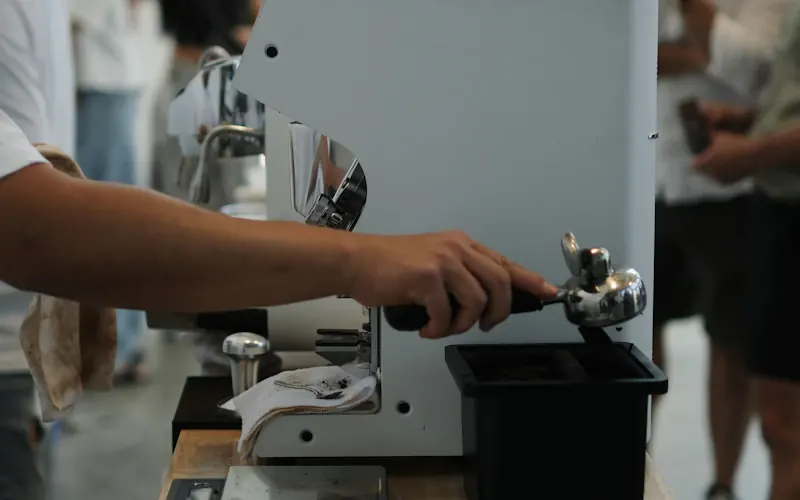
A steam wand looks impressive, but its job comes down to two moves: injecting air as microbubbles into the milk, then heating it to set that foam. The whole point of home frothing is to reproduce those two steps with what you already have in the kitchen.
Foam structure comes from milk proteins: they form a genuine net that traps air and stabilises the bubbles. The fat brings the creaminess and the hold. That is why whole milk, richer in protein (around 3.2 g per 100 ml) and fat (around 3.5%), produces a denser, more stable foam than skimmed or non-barista plant drinks. Among plant-based options, barista versions compensate with added protein and stabilisers.
Which home methods froth milk, step by step?
1. The shaken jar then the microwave
This is the most accessible method and one of the finest. The shaking injects the air, the microwave sets the foam.
- Pour cold milk into a jar with an airtight lid until it is one third full. Do not fill more: the foam needs room to rise.
- Close the lid tightly and shake hard for 30 to 60 seconds, until the volume roughly doubles.
- Remove the lid (important before microwaving) and microwave the open jar for 30 to 45 seconds. The heat stabilises the foam and brings the milk to drinking temperature, without exceeding 65 C.
- Tap the jar on the counter to pop the large bubbles, then pour while holding back the foam with a spoon.
2. The French press
The plunger acts like an ultra-fast whisk that beats in a mass of fine bubbles. The result is a silky foam, close to that of a steam wand.
- Heat the milk to 60-65 C (pan or microwave), then pour it into the French press beaker no more than one third full.
- Fit the lid with the plunger and work it up and down for 30 to 45 seconds, without going all the way down so it draws in air.
- Remove the plunger, tap the base on the counter and let it rest for 30 seconds to even out the foam.
- Pour: the French press gives one of the finest foams possible without a machine.
3. The battery frother
A small electric spiral whisk, this is the fastest and tidiest tool of the lot.
- Heat the milk to 60-65 C in a tall, narrow container (mug, jug).
- Dip the whisk just below the surface and switch it on.
- Run it for 20 to 30 seconds, slowly raising the whisk to create a whirlpool that pulls in air.
- Tilt the container slightly near the end to refine the texture, then pour.
4. The hand whisk
The fallback, with no special tool. The foam is coarser but still usable.
- Heat the milk to 60-65 C in a pan or a wide bowl.
- Whisk vigorously with fast back-and-forth strokes for 1 to 2 minutes, keeping the whisk near the surface to fold in air.
- Keep going until it foams clearly, then serve at once: this foam collapses faster than the others.
How do you get a smooth, stable milk foam?
- Respect the 60-65 C window. That is where milk tastes sweetest and proteins hold air best. A kitchen thermometer helps; without one, stop as soon as the container is too hot to hold for more than a couple of seconds.
- For the jar, start with cold milk. Cold holds the bubbles better while shaking. Heating comes only afterwards, in the microwave.
- Never fill above one third. The foam doubles in volume, so it needs room in the jar and in the French press alike.
- Choose a protein-rich milk. Whole milk preferably, or a barista plant-based drink. Skimmed milk and standard plant versions froth less.
- Tap and let it rest. A few seconds of rest and a tap on the counter pop the large bubbles and give a more even texture.
Which method should you pick for each result?
All these methods work, but they do not give the same texture or the same ease of use. Here is how to choose.
- Finest foam, polished latte or cappuccino: the French press, or the shaken jar and microwave. These are the two best routes to velvety microfoam.
- Speed and simplicity every day: the battery frother. A few seconds, little washing up, a consistently airy result.
- No dedicated kit, just getting by: the hand whisk. Coarser foam, to serve right away.
- Hot drinks like cocoa or matcha: the battery frother or whisk are plenty, since fineness matters less than on a coffee.
In practice, many home drinkers keep a French press for the weekend and a battery frother for busy mornings. Together they cover most needs without ever pulling out a machine.
Frequently asked questions
Can you really froth milk without a machine?
Yes. A steam wand only does two things: it injects air into the milk and heats it to stabilise the foam. You reproduce both at home with a shaken jar that you then microwave, the plunger of a French press, a battery frother or a simple whisk. The jar and the French press give the finest foam. The shared secret is never to go above 65 C.
Which milk froths best without a machine?
Whole milk froths best: its proteins (around 3.2 g per 100 ml) form the net that traps air, while its fat (around 3.5%) makes the foam creamy and stable. Among plant-based options, barista drinks (oat, soy) are formulated with extra protein and stabilisers, which brings them closer to whole milk. Standard non-barista versions froth less well.
What temperature should milk be to froth it?
Aim for 60 to 65 C. In that range the milk's natural sugars come through and taste sweet, and the proteins are primed to hold air for a stable foam. Above 65 C the milk denatures: the proteins break down and lose their ability to hold foam, and a scalded taste appears. For the jar method, start with cold milk so it shakes up better, then heat afterwards.
Why start with cold milk for the jar method?
Cold milk holds air bubbles better while you shake, so the foam builds faster and lasts longer. Only after shaking do you microwave it, to set the foam and bring the milk up to drinking temperature. By contrast, the French press, frother and whisk all need milk already heated to 60-65 C before you add air.
Go further: Specialty coffee FAQ · All guides · Coffee glossary