☕ Key takeaways
- Costa Rica legally permits only Arabica cultivation, guaranteeing a minimum quality floor across the entire national production.
- Tarrazú is the most internationally recognised region for its clean, balanced coffees; Tres Ríos produces more elegant, delicate micro-lots often from small farms.
- Honey process is a Costa Rican speciality: by retaining part of the mucilage during drying, it produces a profile between washed (clarity) and natural (fruitiness), developed locally to conserve water.
Costa Rican Coffee Guide: Tarrazú, Tres Ríos, Honey Process
What are the three key facts about Costa Rican coffee?
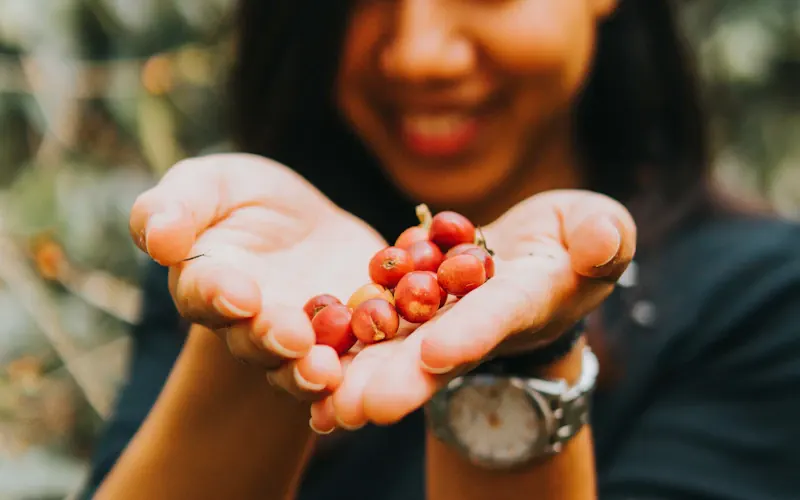
- Costa Rica is often described as the most "clean" and structured coffee country in Central America. That reputation is earned. This small country legally banned robusta…
- Coffee arrived in Costa Rica from Cuba in 1779. Production spread rapidly through the central valleys in the nineteenth century, supported by both colonial and then republican…
- Costa Rica's transparency makes informed buying easier: producers are well documented, cooperatives well structured, certifications (ICAFE, Rainforest Alliance, organic) well…
Costa Rica is often described as the most "clean" and structured coffee country in Central America. That reputation is earned. This small country legally banned robusta cultivation in 1989, maintains high quality standards at export, and developed a dense network of micro-beneficios (micro-processing stations) that allow small producers to control their process from fruit to green bean. It also pioneered the honey process, that intermediate treatment between washed and natural, which has now travelled the entire specialty world. This guide covers everything: Tarrazú and Tres Ríos, the mechanics of honey processing in its different expressions, and how to choose a Costa Rican coffee that genuinely reflects the quality the terroir can deliver.
Why did Costa Rica make pure arabica a matter of state policy?
Coffee arrived in Costa Rica from Cuba in 1779. Production spread rapidly through the central valleys in the nineteenth century, supported by both colonial and then republican governments that saw coffee as an engine of economic modernisation. The 1989 decision to ban robusta is emblematic of Costa Rica's positioning: quality over volume. The country deliberately sacrificed some price competitiveness to build a lasting premium arabica reputation. That strategy paid off: Costa Rica established itself as a benchmark for processing standards and traceability in Central America, attracting specialty roasters' attention from the 1990s onward.
What shapes Costa Rican terroir across its central valleys and volcanic slopes?
The Central Cordillera running north-west to south-east through Costa Rica creates a series of highly distinct microclimates. Coffee zones extend on both sides of this ridge, between 1,000 and 1,900 m altitude, benefiting from volcanic soils (particularly around the Poás, Barva and Chirripó volcanoes) and a bimodal rainfall pattern that allows two harvest seasons in some regions. The Central Valley (San José, Heredia, Alajuela) is the historical heartland of Costa Rican coffee. Further south, Tarrazú, in the Talamanca Cordillera, is today the country's most prized region. Tres Ríos, just south-east of San José, is a tiny enclave of very high quality despite (or because of) its small size and proximity to the capital.
How did Tarrazú become Costa Rica's internationally acclaimed flagship?
Tarrazú is the name the world instinctively associates with quality Costa Rican coffee. Centred around the town of San Marcos de Tarrazú at roughly 1,400-1,800 m in the Talamanca mountains, the region benefits from ideal cool temperatures, mineral-rich soils and a well-defined dry season that facilitates coffee drying. The Tarrazú profile is recognisable: full to medium body, lively but well-structured acidity, hazelnut, caramel, citrus (bitter orange, lemon) and occasionally a hint of blackcurrant. It is a versatile coffee, excellent as a pour-over but robust enough to handle a medium-dark roast for espresso fans who want character. The sector is overseen by ICAFE (the Coffee Institute of Costa Rica).
What gives Tres Ríos coffees their quiet Costa Rican elegance?
Tres Ríos is a geographical anomaly: a high-quality coffee zone encircled by the eastern suburbs of San José, progressively being eaten by urban sprawl. The plantations that survive, at 1,400-1,600 m on Barva volcanic soils, produce coffees of remarkable elegance, light in body, floral, with a luminous acidity that can evoke the best Kenyan washed coffees. It is a commercially difficult region to access, low volumes, few producers, but the specialty roasters who work there report coffees of great finesse, perfect for palates seeking subtlety rather than power. A Tres Ríos tends to cost more than a comparable-quality Tarrazú, simply because supply is limited.
How does the Costa Rican honey process work, from mucilage to cup?
The honey process was born in Costa Rica in the 2000s, popularised by producer-processors seeking a middle ground between washed clarity and natural intensity. The principle: the cherry is depulped (as for washed) but the bean is not washed, all or part of the mucilage (the sticky sweet layer surrounding the parchment) is retained during drying. This mucilage dries onto the bean and gives it a caramelised character, hence the name "honey".
| Honey type | Mucilage retained | Cup profile | Drying time |
|---|---|---|---|
| Yellow honey | 25-30% | Close to washed, slightly sweeter | 8-10 days |
| Red honey | 50% | More body, yellow fruit, marked sweetness | 12-16 days |
| Black honey | 100% (maximum) | Very sweet, full body, approaching natural | 20-30 days |
Cup results vary by colour: yellow honey stays close to a clean washed with added softness; red honey brings more body, yellow fruits (peach, mango) and caramel; black honey, dried very slowly, can reach a sweetness intensity approaching a natural with less fermentation. The finest Costa Rican honeys combine Tarrazú terroir with red or black mucilage retention for coffees of remarkable complexity.
Which coffee varieties does Costa Rica grow, from Villa Sarchi to rust-resistant hybrids?
Costa Rica developed several proprietary arabica varieties through CATIE (Tropical Agricultural Research and Higher Education Center) and ICAFE. Villa Sarchi is the best known: a local Bourbon mutation adapted to Costa Rican rainfall and wind patterns, with interesting natural resistance. It delivers floral, acidic cups often compared to the best Central American Bourbons. Catuaí and Caturra dominate overall production volume. More recently, certain rust-resistant hybrids were introduced to protect production against orange rust (Hemileia vastatrix), which threatens classic arabicas in an era of climate change.
How do you recognise and buy quality Costa Rican coffee?
Costa Rica's transparency makes informed buying easier: producers are well documented, cooperatives well structured, certifications (ICAFE, Rainforest Alliance, organic) well maintained. Always look for the region (Tarrazú, Tres Ríos, West Valley), the altitude, the honey type if applicable, and the roast date. A honey process coffee must specify the colour (yellow, red, black), a bare "honey" mention without detail is insufficient. Belgian specialty roasters working with Costa Rica can often specify the farm or micro-beneficio of origin.
Costa Rica is the country where coffee processing became an art form in its own right. Before choosing an origin, choose a process: a Tarrazú black honey and a Tarrazú washed from the same producer are two radically different experiences. Explore both.
Why is honey processing Costa Rica's technical signature?
Costa Rica's most distinctive contribution to the global specialty coffee conversation is the honey process, a technique the country has refined to a level of sophistication that few other origins match. Understanding honey processing in the Costa Rican context explains both the country's flavour reputation and its position in the specialty market at a premium above its Central American neighbours.
Honey processing in Costa Rica is classified by mucilage retention level and the colour designation that results from different drying durations: white honey (minimal mucilage, fastest drying), yellow honey (moderate mucilage, approximately 8 days of drying), red honey (substantial mucilage, 12-15 days), and black honey (maximum mucilage retention, 25-30 days of slow drying with frequent turning). The colour designations refer to the colour the drying parchment takes on from the caramelising sugars, not to any characteristic of the final roasted bean. The flavour gradient across these four types is significant: white honey resembles a clean washed coffee with slightly more body; black honey approaches the fruit-forward character of natural processing while retaining more clarity and less fermentation complexity.
The micro-mill revolution, where individual farms established their own small-scale processing facilities rather than delivering cherries to centralised wet mills, enabled this level of honey process precision. Before micro-mills, Costa Rican coffee was processed at cooperative or commercial wet mills that aggregated cherries from hundreds of farms, making lot separation and processing experimentation impossible. The ability to process a single farm's cherries through a small-scale depulper with adjustable mucilage settings created the conditions for the honey process innovation that now defines Costa Rica's specialty identity.
Tarrazú and Tres Ríos produce the highest concentration of honey-processed specialty coffees in Costa Rica, with altitude and soil conditions that support the slow, controlled drying that black and red honey require. Coffees from these regions at honey processing typically show caramel sweetness, stone fruit character, and a balanced acidity that positions them as exceptionally versatile, suitable for both filter and espresso preparation without recipe adjustment.
How do you read a Costa Rican specialty coffee label in practice?
Costa Rican specialty coffee labelling has become relatively sophisticated compared to many other origins, reflecting the country's long engagement with the specialty market and the educational investment of micro-mill producers in communicating their product's identity. Understanding what each label element signifies helps evaluate quality and price positioning accurately.
The region designation is more meaningful in Costa Rica than in many origins because the country's defined coffee-growing zones, Tarrazú, West Valley, Central Valley, Tres Ríos, Brunca, Turrialba, Orosi, Guanacaste, have genuinely distinct terroir profiles that experienced tasters can distinguish. Tarrazú is the most internationally recognised name and commands the highest premium, but West Valley producers (particularly around Palmares and Naranjo) have produced competition-grade coffees that rival Tarrazú in cup quality at slightly lower prices. Regional reputation does not always match quality in a given year: terroir matters, but so do harvest management and processing skill in each season.
Altitude information on Costa Rican specialty bags is generally reliable and meaningful. Coffees grown above 1600 metres, particularly in Tarrazú, where some farms reach 1900+ metres, will typically show higher acidity, more developed sweetness, and greater flavour complexity than lower-altitude lots from the same region. When two coffees from the same region and processing type are compared, altitude is a useful proxy for cup quality and an indicator that justifies price differences between them.
Variety information is less frequently displayed on Costa Rican specialty bags than in Colombian or Ethiopian contexts, partly because the variety landscape is less dramatically diverse, Caturra and Catuaí dominate, with emerging interest in Gesha and Bourbon. When variety is specified, Gesha (or Geisha) indicates a premium micro-lot and justifies higher price scrutiny based on SCA score and sourcing transparency. Caturra or Catuaí at comparable prices should be evaluated on processing quality and altitude rather than variety prestige.