☕ Key takeaways
- Cold brew is made by steeping coarsely ground coffee in cold water for 12-24 hours, cold extraction produces a smoother, less acidic and naturally sweeter result than hot-brewed coffee.
- The base ratio is 1:5 (coffee to water) for a concentrate you dilute, or 1:8 to 1:10 for a ready-to-drink brew; a filtered concentrate keeps 7 to 10 days refrigerated, a ready-to-drink batch 5 to 7 days.
- Filtration is the critical step: fine filters (paper or cloth) remove particles and ensure clarity, insufficient filtration gives a gritty texture and residual bitterness.
Cold Brew Coffee Guide: Long Immersion, Ratio, Filtration, Storage
3 key takeaways
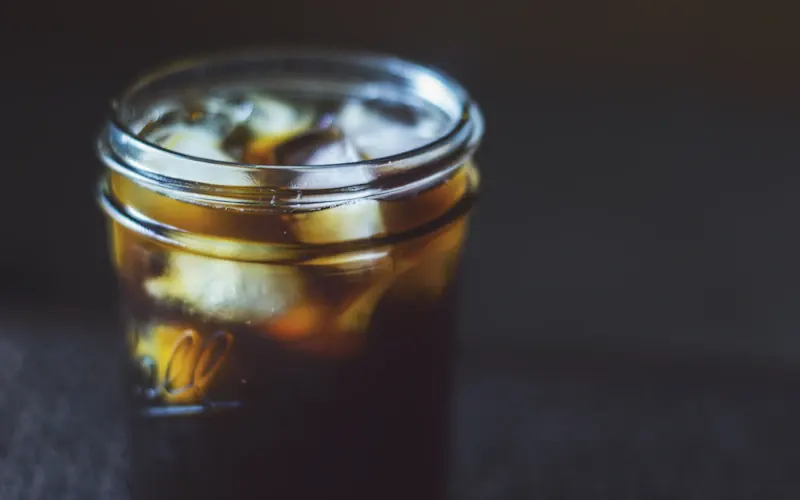
- Cold brew is a brewing method in its own right, not hot coffee that has been chilled: the absence of heat changes what actually dissolves into the cup.
- A working recipe: 100 g of coarsely ground coffee, 500 g of cold water, 12 to 24 hours in the fridge, then two-stage filtration through mesh and paper.
- Medium to dark roasts with chocolate, caramel and hazelnut notes suit cold brew best; very light roasts need a tighter ratio and a shorter steep to avoid under-extraction.
Cold brew is not simply iced coffee or chilled coffee. It's a fundamentally different brewing method that produces a cup with a radically different flavour profile from any hot extraction. The absence of heat slows solubilisation dramatically, suppresses harsh volatile acids, and allows natural sweetening compounds to emerge slowly over the long steep. The result is a coffee that is remarkably smooth, naturally sweet, low in bitterness, and concentrated, without a single gram of added sugar. Once you understand why cold brew tastes the way it does, you'll appreciate it as something genuinely unique rather than a warm-weather substitute.
Why does cold brew taste sweeter and less bitter than hot coffee?
Temperature drives extraction kinetics: roughly speaking, every 10 °C drop halves the solubilisation rate. Cold water extraction (4-8 °C) therefore takes 12 to 24 hours where hot water extraction (93 °C) takes just 3 to 4 minutes. But the difference isn't only in speed, it's also in what gets extracted. Worth knowing before you plan an all-night steep: Fuller and Rao, in Scientific Reports in 2017, found that caffeine and chlorogenic acid reach extraction equilibrium between 6 and 7 hours in cold brew, and that grind size barely moved those two figures. What keeps changing after that is the aromatic profile, not the strength.
The perceived acids that give bright, sparkling notes to hot coffee (citric, malic) extract less efficiently in cold water. Meanwhile, natural sugars and the products of the Maillard reaction, the chocolate, caramel, and toasted notes, dissolve progressively over the long immersion period. The structural result is a brew that tastes sweeter and rounder than a hot extraction of the same beans. One popular claim deserves correction, though: cold brew is not chemically low-acid. Chlorogenic acid concentrations come out comparable between the two methods, and so does pH.
What ratio, grind and steep time should cold brew use?
| Parameter | Concentrate (recommended) | Ready-to-drink |
|---|---|---|
| Coffee-to-water ratio | 1:5 (100 g/500 g) | 1:8 to 1:10 (80 g/700 g) |
| Grind size | Coarse (French press) | Coarse to very coarse |
| Water temperature | Cold (4-8 °C) or room temp | Cold preferred |
| Steep time | 12-24 h in fridge | 8-12 h in fridge |
| Steep location | Refrigerator | Refrigerator |
| Storage (after filtering) | 7-10 days refrigerated | 5-7 days refrigerated |
How do you brew cold brew step by step?
- Choose your vessel: an airtight glass jar, a lidded pitcher, or a dedicated cold brew maker (Hario Mizudashi, OXO Cold Brew, etc.). Capacity should match your intended volume.
- Weigh and grind: 100 g of coffee, coarse grind (similar to French press, or even slightly coarser). Consistent grind size is important for even extraction over such a long time.
- Combine coffee and water: add coffee to the vessel, pour in 500 g of cold filtered water. Stir thoroughly with a spoon to ensure all coffee is saturated and there are no dry pockets.
- Cover and refrigerate: seal tightly and place in the fridge. Fridge extraction (4-8 °C) produces a cleaner, more delicate profile than room-temperature extraction (20-22 °C), which is faster but can develop fermented notes beyond 18-20 hours.
- Choose your steep time: 12 hours gives a light, floral, less concentrated brew; 18 hours the ideal balance for most coffees; 24 hours an intense, full cup that turns slightly more bitter. Beyond 24 hours, the risk of over-extraction and fermentation increases significantly.
- Two-stage filtration: run a fine mesh strainer or metal filter first to remove the bulk grounds, then a paper coffee filter (or Chemex filter) placed in a funnel to remove fines and achieve a crystal-clear brew. This double filtration is the key to great-looking, great-tasting cold brew.
- Store and dilute: transfer the concentrate to an airtight glass bottle and keep it refrigerated for 7 to 10 days at most. Coffee sits at a pH near 5, above the acidity threshold that protects sharper drinks, so cold storage is doing real work here. When serving, dilute 1:1 with cold water, milk, oat milk, or tonic water. Label with the date.
How do you rescue a bitter, flat or cloudy cold brew?
| Symptom | Likely cause | Fix |
|---|---|---|
| Bitter, harsh taste | Steep too long or grind too fine | Reduce to 12-16 h, use coarser grind |
| Flat, characterless cup | Ratio too low, steep too short | Increase to 1:5, steep 18-24 h |
| Fermented or sour taste | Room-temperature steep too long | Reduce to 12-14 h or move to fridge |
| Very cloudy, sediment-heavy | Insufficient filtration | Two-stage filtration: mesh strainer + paper filter |
| Too weak despite long steep | Grind too coarse | Slightly finer grind |
| Tastes "old" after 3 days | Inadequate storage or non-airtight vessel | Airtight glass bottle, consume within 7 days |
Find on Amazon
Affiliate links: as an Amazon Associate, expertcafe.be earns from qualifying purchases, at no extra cost to you. Learn more.
What can you mix into cold brew concentrate?
Cold brew tonic: 80 ml cold brew concentrate over 150 ml tonic water and ice. The tonic's bitterness and the cold brew's sweetness complement each other perfectly. Add a citrus peel to brighten fruity notes.
Cold brew with oat milk: Dilute 1:1 with cold oat milk. The natural sweetness of oat amplifies the chocolate and caramel notes without any added sugar.
Room-temperature cold brew: If fridge space is limited, room-temperature extraction at 20-22 °C works in 8-12 hours. Monitor carefully to avoid fermentation and filter as soon as the profile is to your taste.
Which mistakes ruin homemade cold brew?
- Espresso grind for cold brew: a fine grind clogs the filters and produces bitter, cloudy cold brew. The grind must be coarse.
- Skipping the paper filter: without paper filtration, cold brew stays cloudy and its fines continue extracting even after straining, increasing bitterness over days.
- Keeping it longer than 10 days: after 10 days, even well-filtered, properly stored cold brew develops fermented notes and loses freshness. Brew in manageable batches.
- Using low-quality coffee: cold extraction doesn't mask flaws the way heat does. Use fresh, quality beans for the best result.
Which coffees suit cold brew best?
Cold brew works well with medium to dark roasts that express chocolate, caramel, and hazelnut notes, these compounds dissolve well over long extraction. Brazilian, Colombian, and Ethiopian natural process coffees make outstanding cold brews. Very lightly roasted coffees can yield surprising results (floral, fruity cold brew), but require a higher concentration ratio and shorter steep time to avoid under-extraction.
Cold brew proves that temperature isn't just an extraction parameter, it's a stylistic choice that changes the fundamental nature of the coffee. An 18-hour cold steep and a 3-minute hot extraction of the same beans produce two beverages that seem to come from entirely different origins.
Is cold brew really less acidic than hot coffee?
Cold brew is routinely sold as "smooth" and "low acid", and only half of that holds up to measurement. Knowing what actually changes when coffee is extracted at 4-20 °C rather than 93 °C explains both the sensory character of cold brew and why certain coffees suit cold extraction better than others.
Temperature directly affects the solubility and extraction kinetics of different coffee compounds. The organic acids responsible for coffee's brightness, citric, malic, acetic, and quinic acids, have lower extraction rates at cold temperatures. Rao and Fuller, in Scientific Reports in 2018, found hot brews carried higher total titratable acidity than cold brews of the same coffees, while pH values sat in a comparable 4.85 to 5.13 band for both methods. That pair of results is the whole story: cold brew has fewer acids in solution, which the palate reads as roundness, but it is not a chemically low-acid drink, and anyone avoiding acidity for medical reasons should not treat it as one. Chlorogenic acid concentrations, measured in the companion 2017 study, also came out comparable between cold and hot extraction rather than dramatically lower.
The aromatic profile of cold brew is different from hot brew in ways that go beyond simple attenuation. Certain volatile aromatic compounds, the florals and high-note citrus characteristic of Ethiopian washed coffees, are more heat-sensitive than the earthy, chocolatey, and caramel compounds common in Brazilian and Colombian coffees. Cold brew of an Ethiopian natural retains its fruit character but mutes the bright florals; the result is a cold brew that emphasises dark fruit and chocolate over jasmine and bergamote, a different but coherent flavour profile. Colombian medium-roast coffees tend to express very well in cold brew because their balanced profile, moderate acidity, substantial body, chocolate and caramel notes, remains harmonious after cold extraction, and the muted acidity doesn't flatten an already-moderate profile into blandness.
Cold brew concentrate is a distinct product from ready-to-drink cold brew. Concentrate is brewed at ratios of roughly 1:4 to 1:8 (coffee to water), typically landing somewhere between 3 and 7% total dissolved solids, and is meant for dilution before drinking. Ready-to-drink cold brew uses 1:8 to 1:15 ratios and is poured straight over ice. The commercial market leans on concentrate because it cuts storage volume and limits the amount of water in which degradation can occur. Home brewers with a crowded fridge, or who work through a batch slowly, choose it for the same two reasons.
Why do fridge and room-temperature cold brew need different steep times?
Cold brew's reputation for forgiving brewing masks the reality that its four primary variables, ratio, extraction time, temperature, and grind size, interact in ways that produce meaningfully different outcomes and are worth understanding for consistent results.
Ratio is the most direct determinant of cold brew strength, and the most common cold brew error is inconsistent ratio measurement. Because cold brew uses large volumes of water over long extraction periods, small ratio variations compound: a 1:10 ratio versus a 1:12 ratio at 750 grams of coffee produces either 7.5 or 9 litres of water, a 1.5 litre difference that has significant flavour impact. Using weight measurement (grams) rather than volume (cups or litres estimated by eye) is the single most effective practice for cold brew consistency.
Extraction time interacts with temperature in a way that requires calibration rather than rule-following. Cold brew at 4 °C (refrigerator) extracts more slowly than cold brew at 20 °C (room temperature): the same ratio and grind size will typically require 18-24 hours at refrigerator temperature versus 10-14 hours at room temperature to reach equivalent extraction. Room-temperature cold brew is faster but risks off-flavour development in extended extraction or warm ambient conditions, fermentation can begin if extraction extends beyond 16-18 hours at temperatures above 22 °C. Refrigerator cold brew is slower and more forgiving, suitable for leaving unattended for 18-24 hours without monitoring.
Grind size for cold brew is coarser than most filter brewing, typically equivalent to the coarsest setting on a hand grinder, or approximately 1000-1200 microns. This coarser grind prevents over-extraction during the long immersion time: at fine grind size, the extended contact period would extract tannins and bitter phenolics that hot brewing avoids through shorter contact time at higher temperature. Over-extraction in cold brew manifests as a harsh, bitter, astringent brew, similar to a very over-extracted hot coffee but without the temperature to dissipate quickly from the palate.