☕ Key takeaways
- A €500 filter setup (burr grinder + V60 + gooseneck PID kettle) often produces a higher-quality cup than a poorly calibrated €1,000 espresso setup.
- The grinder weighs more than any other component in the quality equation: investing in a quality burr grinder takes priority over the brewer or machine itself.
- For a €1,000 espresso setup, the grinder-machine balance is critical, a quality grinder paired with an entry-level machine typically outperforms a mediocre grinder with a premium machine.
Coffee Enthusiast Guide: €500 Filter or €1000 Espresso Setup
What should you know before choosing between a filter and an espresso setup?
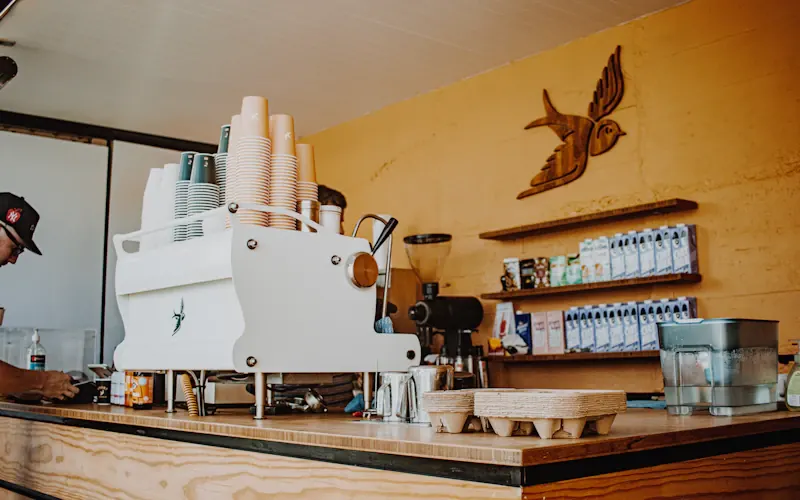
- You've moved past the pod machine and the instant coffee phase. You've started reading about grind size, bloom times, and origin profiles. Now comes the real question: do you…
- Espresso is a demanding method. You're pushing water at 9 bars of pressure through 18-20g of finely ground coffee in 25-30 seconds, at 92-94°C. Getting this right consistently…
- Before buying anything, go taste. Visit specialty coffee bars in Belgium, places like La Baie Coffee (Waterloo), Naga Coffee (Rixensart), or the specialty shops in Brussels, Ghent and Antwerp.
You've moved past the pod machine and the instant coffee phase. You've started reading about grind size, bloom times, and origin profiles. Now comes the real question: do you invest around €500 in a complete filter setup, or stretch to €1,000 for a proper espresso station at home? This guide gives you an honest breakdown, no hype, no affiliate bias, so you can make the choice that actually fits your life.
Why does your budget logic matter more than you think?
The natural instinct is to focus your budget on the machine. It's the object you'll see every morning, the one that impresses guests, the one with the most impressive spec sheet. But here's what experienced home baristas know: the grinder is where your money makes the biggest difference.
A quality burr grinder with consistent grind size distribution is the single biggest factor in cup quality. Uniform particle size means uniform extraction. When particles are different sizes, small ones over-extract (bitter, harsh) while large ones under-extract (sour, flat), and those two problems cancel each other out into a muddled, unsatisfying cup.
The logical consequence: always build your setup grinder-first, regardless of which brewing method you choose.
What does a €500 filter setup actually get you?
At €500, a well-assembled filter setup can be genuinely excellent. Here's how to allocate that budget intelligently:
Conical burr grinder (€200-280)This is the centerpiece. A 48-64mm conical burr grinder produces consistent, low-heat grind suitable for V60, Chemex, AeroPress, and French Press. Look for stepless or very fine stepped adjustment, a quality hopper seal, and a grind chamber that minimizes retention.
Dripper: V60 or Chemex (€30-80)The Hario V60 (ceramic, glass, or metal) produces a bright, expressive cup that highlights acidity and floral notes. The Chemex produces a cleaner, softer cup with more body uniformity. Both reward practice. An AeroPress (€35) is a smart complement, fast, forgiving, and travel-friendly.
Gooseneck kettle with temperature control (€80-150)Underestimated by beginners. A gooseneck allows precise, controlled pouring, essential for pour-over methods. Temperature control (PID) lets you hit 92-96°C depending on roast level. This single piece of kit dramatically improves consistency.
Precision scale with timer (€20-50)Non-negotiable. A 0.1g resolution scale with a built-in timer allows you to maintain a consistent brew ratio (typically 60g/litre) and track extraction time simultaneously.
| Component | Estimated cost | Priority |
|---|---|---|
| Conical burr grinder 48-64mm | €200-280 | Critical |
| V60 or Chemex dripper | €30-80 | High |
| Gooseneck kettle with PID | €80-150 | High |
| Precision scale 0.1g + timer | €20-50 | Critical |
| Quality filters (pack) | €10-20 | Medium |
| Total | €340-580 |
How do you build a €1,000 espresso setup properly?
Espresso is a demanding method. You're pushing water at 9 bars of pressure through 18-20g of finely ground coffee in 25-30 seconds, at 92-94°C. Getting this right consistently requires gear that can hold those parameters stable, and that costs money.
Semi-automatic espresso machine (€500-700)At this price point you access machines with E61 group heads (superior thermal stability), pressure gauges, warming trays, and durable materials. A PID controller for temperature stability is a significant advantage. Ignore the "15 bar pump" marketing, only the 9 bars in the cup matter.
Dedicated espresso grinder (€250-400)Espresso grind is very fine and must be extremely consistent. Flat burrs (38-58mm) are the standard for this segment. A grinder with micro-adjustment steps is essential. An undersized grinder ruins even the best machine.
Essential accessories (€100-150)A 0.1g precision scale, a calibrated 58mm tamper, a tamping mat, a WDT distribution tool, and serving cups. These items seem minor but directly affect shot-to-shot reproducibility.
Filter or espresso at the same budget: which one wins?
| Criterion | Filter setup (€1,000) | Espresso setup (€1,000) |
|---|---|---|
| Daily cup quality | Excellent (premium grinder) | Good (budget constrained by machine) |
| Learning curve | 2-4 weeks to consistency | 3-6 months to dialling in |
| Daily prep time | 4-6 min (simple pour-over) | 15-20 min (warm-up + adjustments) |
| Daily maintenance | Quick rinse | Purging, backflush, descaling |
| Coffee versatility | Works with all roast levels | Best with medium roasts |
| Drink options | Filter coffee only | Espresso + milk drinks (latte, cappuccino) |
| Upgrade path | Easy, modular | Expensive (machine is the big investment) |
Find on Amazon
Affiliate links: as an Amazon Associate, expertcafe.be earns from qualifying purchases, at no extra cost to you. Learn more.
Which setup matches which coffee drinker?
Filter coffee is for you if: you enjoy nuanced, aromatic cups; you drink coffee alone or as a couple in the morning; you're curious about origin flavours (Ethiopian florals, Kenyan citrus, Guatemalan chocolate); you want to start well quickly without months of dialling in; and you don't need milk-based drinks.
Espresso is for you if: you regularly host guests; you love cappuccinos, flat whites, and lattes; you appreciate the concentrated intensity of a ristretto; you're willing to invest time in learning and maintenance; and you're ready to commit to the craft rather than just the result.
Which traps should you avoid in either setup?
All-in-one machinesMachines that combine grinder, filter brewer, and espresso maker in one unit systematically compromise quality at every component to hit a price point. They look impressive in catalogues. They disappoint in the cup.
Cheap grinder, expensive machineThe most common beginner mistake. Spending €700 on a machine and €80 on a grinder produces mediocre results. The grinder is the bottleneck. Always.
Pre-ground coffeeWhatever your setup, pre-ground coffee loses the majority of its volatile aromatics within 15-30 minutes of grinding. Whole beans, fresh roast date, grind just before brewing. No exceptions.
No scaleWorking "by eye" or by volume introduces 2-3g of variability per brew. A 0.1g scale is not optional for repeatable results.
What is your first step, wherever you begin?
Before buying anything, go taste. Taste different brewing methods side by side. Notice what appeals to you: the brightness of a well-made V60, or the intensity of a properly pulled espresso.
The best setup is the one you'll actually use every day. A €300 filter setup with exceptional freshly roasted beans will always outperform a €1,500 espresso machine fed with stale pre-ground coffee. Gear matters. Coffee quality matters more.
What does €500 actually build in a filter setup in 2026?
The €500 filter setup is where most serious coffee enthusiasts should start, and where many who started with espresso eventually return, having discovered that the filter path offers more flavour clarity per euro than any espresso machine at a comparable budget. The reason is simple arithmetic: the most important variable in a home coffee setup is the grinder, and €500 allows you to invest €250-300 in a grinder, enough for genuinely good burr alignment and particle consistency, alongside a brewer and ancillaries without compromise.
At this budget, the grinder options are excellent: the Comandante C40 MK4 hand grinder (around €190) offers burr quality that rivals electric grinders costing three times as much. Its all-glass body and stainless steel burrs produce a particle distribution that extracts cleanly across V60, Chemex, and AeroPress preparations. The alternative in hand grinders, Timemore Chestnut C3 Pro (around €70), is the entry point to serious grinding and performs well enough for daily filter use, leaving more budget for brewing equipment or coffee itself.
For electric grinding at this budget, the Baratza Encore ESP (around €180) and the Timemore Sculptor 064 (around €220) represent the upper tier of sub-€250 electric flat burr grinders. Both produce acceptable particle consistency for filter coffee and basic espresso, though neither is truly optimised for espresso at this price point. The choice between hand and electric is primarily about workflow: hand grinding takes 45-90 seconds per dose and requires physical effort; electric grinding takes 10-15 seconds. For a single daily cup, hand grinding is a viable ritual. For multiple doses or multiple people, electric convenience becomes important.
The brewer in a €500 filter setup costs relatively little, the V60 in ceramic costs €25-35, the AeroPress around €40, the Kalita Wave €35-50. Allocating €30-40 to a quality gooseneck kettle with temperature control (Hario Buono or Fellow EKG entry-level) is a high-value addition: water temperature control is a significant extraction variable, and a standard kettle with no temperature setting makes precision brewing unnecessarily difficult. A kitchen scale with 0.1g resolution and a timer, around €20-40, completes the essential setup. Everything else, specialty barware, multiple brewers, brewing trays, is optional enhancement rather than functional requirement.
What should you expect from the €1000 espresso path?
At €1000, the espresso setup becomes genuinely interesting, but only if the budget is allocated correctly. The most common mistake is over-investing in the machine and under-investing in the grinder. A €700 machine paired with a €300 grinder will produce significantly better espresso than a €900 machine with a €100 grinder, because the grinder's particle consistency is the dominant variable in espresso extraction quality.
At the €350-500 machine price point, several options offer PID temperature control (the minimum requirement for serious espresso at home), a pressurised or semi-commercial group head, and adequate build quality for 5-8 years of daily use. The Gaggia Classic Pro (with PID upgrade, total around €450) and the Breville Bambino Plus (around €430) represent different philosophies: the Gaggia rewards manual skill development and is highly modifiable; the Bambino prioritises automated consistency and ease of use. Neither has the thermal stability of dual-boiler machines, but both are capable of excellent espresso with quality grinders and correct technique.
The grinder budget at €400-500 for this setup should be the focus. The Niche Zero (around €500) is the consensus recommendation in the home espresso community for single-dose grinding with minimal retention, meaning each dose is freshly ground with negligible stale grind carryover. The DF54 (around €200) offers flat burrs at an accessible price point with reasonable espresso performance. The Eureka Mignon Specialita (around €400) is the commercial-grade workhorse that many home baristas keep for a decade without replacement. Any of these paired with a €400-500 machine creates a setup whose limiting factor will be the user's technique development, not the equipment's ceiling.
Technique development for home espresso, learning to distribute grounds evenly, tamp consistently, diagnose extraction by taste, and adjust grind in small increments, takes several weeks of dedicated practice and several kilograms of coffee. This learning curve is real and should factor into the setup decision: someone who wants good coffee without daily experimentation will be happier with a French press and quality hand grinder than with an espresso setup they don't have the time to dial in properly.