☕ Key takeaways
- The AeroPress combines immersion and pressure (0.5-1 bar) for a forgiving, rounded cup; the V60 relies on pure percolation and demands precise pouring technique.
- The V60 better reveals terroir and acidity in delicate coffees; the AeroPress suits bolder coffees and darker roasts, and tolerates grind and temperature imprecision.
- For beginners, the AeroPress is the more forgiving starting point, the V60 punishes small technique errors where the AeroPress simply absorbs them.
AeroPress vs V60 Guide: Which Method for Which Coffee Profile?
What are the key differences between the AeroPress and V60 at a glance?
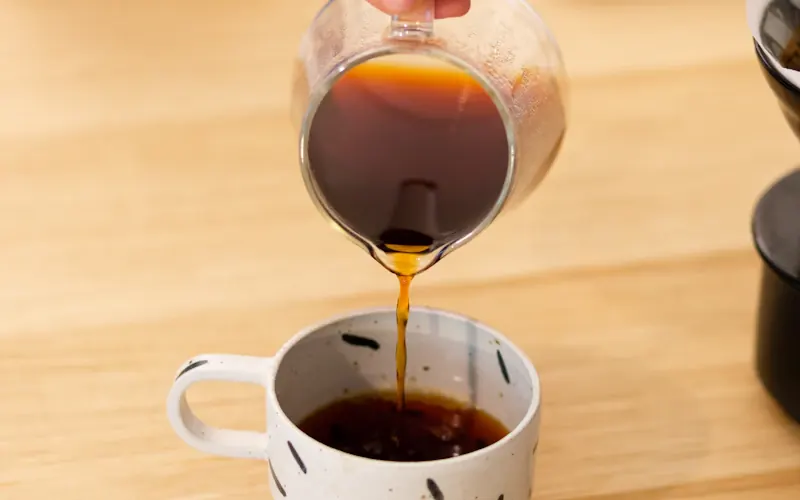
- If you've ever stood in a coffee shop watching a barista pour water in slow spirals over a glass cone, or watched someone press a plastic cylinder like a syringe, you've witnessed…
- The V60 also rewards patience and practice. Once you've learned to pour consistently, 30 ml bloom for 30 seconds, then slow spiralling pours, the results are strikingly…
- Not at all. Many specialty coffee drinkers own both. The V60 lives on the kitchen counter for weekend morning rituals with exceptional single-origin lots. The AeroPress lives in a…
If you've ever stood in a coffee shop watching a barista pour water in slow spirals over a glass cone, or watched someone press a plastic cylinder like a syringe, you've witnessed the two most popular manual brew methods in specialty coffee: the V60 and the AeroPress. Both are celebrated in competitions worldwide, used by champions and curious beginners alike. But they are very different tools, and choosing between them, or understanding when to use which, opens a new dimension in how you experience coffee at home.
How does each brewing method actually work?
The V60 is a pour-over dripper. You place a paper filter inside its cone shape, add ground coffee, and pour hot water over it. Gravity pulls the water down through the coffee bed and through the filter into your cup below. The V60's internal ridges create an air gap that speeds drainage, and the wide single hole at the bottom gives the brewer control over flow rate through pouring technique. The result: a very clean, clear cup where every aromatic compound in the coffee can be tasted individually.
The AeroPress works differently. You place ground coffee in a cylinder, pour water in, and after a short immersion period (during which coffee steeps like tea), you attach a filter cap and press a plunger downward. The manual pressure, typically 0.35 to 0.75 bar, pushes the brewed coffee through the filter and into your cup. Total brew time is under two and a half minutes in most recipes, and the pressure phase lasts only 20-30 seconds. The result: a slightly fuller, more textured cup than the V60, especially when a metal filter is used.
How do the AeroPress and V60 compare side by side?
| Parameter | AeroPress | V60 (Hario) |
|---|---|---|
| Extraction mode | Immersion + manual pressure | Gravity percolation |
| Pressure applied | 0.35-0.75 bar (manual) | 0 bar (gravity only) |
| Typical total time | 1 min 30 s, 2 min 30 s | 2 min 30 s, 3 min 30 s |
| Filter type | Paper micro-disc or metal | Conical paper or metal |
| Oil retention | Partial (paper) or none (metal) | High, paper absorbs most oils |
| Typical coffee dose | 15-18 g for 200-250 ml | 15-20 g for 250-300 ml |
| Recommended grind | Medium-fine (400-600 µm) | Medium-coarse (600-800 µm) |
| Body in the cup | Medium to full (filter-dependent) | Light to very light |
| Aromatic clarity | Good to very good | Excellent |
| Learning curve | Gentle, recipe is easy to repeat | Steeper, pouring technique matters |
| Travel suitability | Excellent, unbreakable, lightweight | Good, fragile if ceramic/glass |
| Approximate price | €35, €45 | €20, €35 |
When should you choose the V60?
Choose the V60 when the coffee you're brewing is worth showcasing. Washed Ethiopian coffees, Yirgacheffe, Guji, Gedeb, express jasmine, bergamot, and stone fruit with exceptional clarity in a V60. Kenyan coffees with their signature blackcurrant and tomato notes sing through a paper filter. Colombian lots from Huila or Nariño reveal elegant floral and citrus layers. For any coffee where the roaster's note says "floral, tea-like, delicate," the V60 is your best vehicle.
The V60 also rewards patience and practice. Once you've learned to pour consistently, 30 ml bloom for 30 seconds, then slow spiralling pours, the results are strikingly repeatable. And unlike the AeroPress, the V60 scales up easily: a larger 03-size cone can brew 500 ml for two people without adjusting technique fundamentally.
When should you choose the AeroPress?
Choose the AeroPress when you want versatility above all else. It handles light, medium, and dark roasts with equal competence by adjusting water temperature and steep time. With a paper filter, you get a clean cup not far from the V60's character. With a metal filter (such as the Able Disk), oils pass freely, giving a richer, more textured result reminiscent of a French press but without the sediment.
The AeroPress is also the undisputed king of travel brewing. It is made of BPA-free polypropylene, weighs 230 g, works with water at 80-96 °C (useful in high-altitude hotels where water never reaches 100 °C), and doesn't require a gooseneck kettle. It has crossed every continent in carry-on luggage and survived countless hotel rooms. The World AeroPress Championship, a genuine annual event held in different cities globally, has produced hundreds of wildly creative winning recipes, proving just how much this simple tool can do.
How do you brew the inverted AeroPress recipe?
The inverted AeroPress method involves placing the device upside down (plunger first), adding coffee and water, steeping without any drip, then flipping the whole thing onto a cup and pressing. This technique gives complete control over steep time and prevents any water from draining prematurely through the filter. It's particularly useful for very lightly roasted coffees that need a longer contact time to develop fully. Many World AeroPress Championship recipes use this approach.
Do You Have to Choose?
Not at all. Many specialty coffee drinkers own both. The V60 lives on the kitchen counter for weekend morning rituals with exceptional single-origin lots. The AeroPress lives in a travel bag or a work drawer for everyday quick brews. The combined cost is under €80, modest compared to most kitchen gadgets, and the brewing education you get from using both is invaluable. Each teaches you something different about how coffee extracts, and that knowledge applies to every other method you'll ever try.
The V60 is a spotlight on your coffee, it reveals everything. The AeroPress is a reliable partner that adapts to wherever you are. Both deserve a place in a coffee lover's toolkit.
How do grind size, ratio, and water temperature differ between the two?
When James Whitfield first sat down to compare the AeroPress and the V60 seriously, not just brewing one after the other, but dialling in each with the same coffee, same roast date, same water, he was struck by how much the two methods diverge before a single drop of water is poured. The grind size for a well-extracted V60 is typically medium-fine: particles around 600-800 microns, opening enough surface area for a clean, even percolation through the Hario paper. The AeroPress invites experimentation across a much wider range. Inverted AeroPress recipes often call for a finer grind than most people expect, sometimes approaching espresso territory for short, concentrated pulls. The standard orientation tends to work best with a medium grind, but the margin for adjustment is considerably wider than the V60 tolerates.
Water temperature reveals the same pattern of flexibility versus precision. The V60, particularly with light-roasted African coffees, is happiest between 92 °C and 96 °C, too cool, and the bright acids go flat; too hot, and the delicate florals turn acrid. The AeroPress handles a broader thermal window with grace. Some of the most celebrated AeroPress World Championship recipes have used water at 80-85 °C for specific beans, coaxing unusual sweetness from coffees that would fall apart on a V60 at the same temperature. This isn't sloppiness, it's the AeroPress capitalizing on its sealed, pressurized environment to extract compounds that open-vessel methods at the same temperature cannot reach.
Ratio differences are equally instructive. The V60 almost universally operates at 1:15 to 1:17 coffee to water by weight. The AeroPress is genuinely bipolar in its possibilities: recipes range from 1:6 (intense concentrate, meant for dilution) to 1:18 (a light, tea-like filtration approaching Chemex territory). This versatility is real, not theoretical, it changes the fundamental sensory contract of the cup. Understanding which mode you're in, and why, is more important than following any single "correct" recipe.
What does the AeroPress's pressure actually change in the cup?
The AeroPress applies pressure. The V60 relies on gravity alone. This isn't a minor detail, it fundamentally changes the extraction chemistry in ways that are measurable with a refractometer and perceptible in the cup.
Pressure in the AeroPress is relatively modest compared to espresso, roughly 0.5 to 1 bar from manual pressure, compared to 9 bars for espresso. But this small increment above atmospheric pressure is enough to push water through a coffee bed faster and to extract certain compounds, particularly body-contributing lipids and some heavier aromatic molecules, that gravity alone leaves behind. The result is a cup with noticeably more body and mouthfeel than a V60 brewed at the same ratio and temperature with the same coffee. This body is a feature or a bug depending on what you're after: for a Kenyan SL28 that already has substantial structure, the AeroPress body can tip into heaviness; for a delicate Ethiopian washed that risks feeling thin, it provides welcome substance.
The V60's gravity-fed extraction is slower and gentler. The water passes through the coffee bed without pressure, relying entirely on grind size, temperature, and pour technique to control extraction rate. This makes the V60 extraordinarily transparent, faults in the coffee (poor density, stale roast, uneven grind distribution) are faithfully reproduced in the cup. The same quality of transparency applies to the coffee's virtues: a beautifully processed Ethiopian Yirgacheffe will sing through a V60 in a way that the AeroPress's body and pressure slightly veil.
For the home brewer deciding between the two, this distinction matters practically. If you want to understand a coffee deeply, to learn its character, its origin expression, its roaster's intentions, the V60 is the more truthful instrument. If you want a consistently enjoyable cup with more room to correct for grind inconsistencies or slightly stale coffee, the AeroPress's forgiveness and pressure-assisted body make it the more practical daily companion.
How do cleaning and portability shape the everyday choice?
Brewing methodology aside, the AeroPress versus V60 decision often comes down to practical factors that no taste test resolves. Cleaning the AeroPress takes approximately 20 seconds: pop the puck, rinse the chamber, done. The V60 requires rinsing the dripper and disposing of the saturated paper filter, a slightly longer process that becomes cumbersome if you're travelling or operating in a space without easy water access.
Portability is the AeroPress's strongest argument outside the laboratory. It packs flat, weighs under 250 grams in the travel version, and has survived everything from Himalayan basecamp brewing to transatlantic carry-on luggage. The V60, particularly in glass or ceramic form, is more fragile, though the Hario plastic V60 addresses this reasonably well at the cost of some heat retention compared to the ceramic version.
For the travelling coffee enthusiast who wants one method and one only, the AeroPress wins on practicality almost every time. For the home brewer who has established a ritual space and wants to develop a nuanced understanding of how grind, temperature, and pour interact, the V60 offers a richer learning journey. Many serious coffee people eventually own both, they're complementary tools rather than competitors, each revealing different facets of the same extraordinary ingredient.